

Slow productivity is the most counterintuitive idea in modern work — and also the most necessary. For almost two decades, hustle culture told us the formula was simple: more hours, more output, more success. Wake up at 5 AM. Fill every minute. Answer emails at midnight. Wear exhaustion like a badge of honor. And if you weren’t overwhelmed, it probably meant you weren’t trying hard enough.
Then the data arrived. Employee burnout now affects 67% of all workers globally, according to Gallup’s 2026 research. Stanford University found that productivity per hour declines sharply once a workweek exceeds 50 hours — meaning all those extra hours aren’t producing extra results. They’re just producing extra exhaustion. And 74% of employees report having experienced burnout at their current job, while 61% of HR professionals say burnout has increased in the past year alone.
Hustle culture didn’t deliver on its promise. Slow productivity is the honest alternative — and in the summer of 2026, it has become one of the most searched, most discussed, and most needed shifts in how we think about work.
What Is Slow Productivity?
Slow productivity is not laziness with better branding. It’s not an excuse to do less. It’s a philosophy — most clearly articulated by Cal Newport in his book of the same name — built on three deceptively simple principles:
Do fewer things. Not everything on your list deserves your attention. Most of it is noise. Slow productivity asks you to be ruthless about what actually matters and let go of the rest without guilt.
Work at a natural pace. Human beings are not machines. We have energy cycles, attention cycles, creative cycles. Slow productivity works with those rhythms rather than overriding them with caffeine and willpower.
Obsess over quality. When you do fewer things, you can do them extraordinarily well. The output of slow productivity isn’t less work — it’s better work, produced without the cognitive fog of chronic overload.
The reason slow productivity is resonating so powerfully in 2026 is that it’s not a wellness trend or a productivity hack. It’s a structural correction. Hustle culture was never sustainable, and the burnout statistics have finally made that undeniable. Slow productivity is what comes after you accept that doing more doesn’t mean producing more — and that your most meaningful work happens in the spaces you protect, not in the gaps between distractions.

Why Hustle Culture Failed Us
Before we get into the five strategies, it’s worth sitting with why we got here in the first place — because understanding the failure of hustle culture is what makes slow productivity feel like relief rather than compromise.
The promise of hustle culture was straightforward: effort is the primary input, and more effort produces more output. Work longer. Respond faster. Schedule tighter. The logic felt airtight. It also turned out to be largely wrong.
Research from Stanford demonstrates that once you work more than 50 hours a week, each additional hour produces progressively less output — and beyond 55 hours, almost none at all. You’re essentially working for free, cognitively. And the costs compound: 82% of employees globally are at risk of burnout, according to the Mercer Global Talent Trends report, and burnout costs U.S. employers $322 billion annually through lost productivity and turnover.
The cruel irony of hustle culture is that in the pursuit of maximum productivity, it destroyed the conditions that productivity actually requires: focus, energy, creativity, and cognitive clarity. You can’t do your best thinking when you’re running on three hours of sleep and seventeen unread Slack messages. You can’t solve hard problems when your attention is permanently fragmented across twenty-three open browser tabs.
Slow productivity doesn’t ask you to work less because work is bad. It asks you to work differently because the evidence — finally, clearly — shows that the way most of us have been working isn’t actually working.
5 Ways to Practice Slow Productivity
1. Slow Productivity Starts with a Ruthless Priority List
The first and most important practice of slow productivity is learning to say no to almost everything so that you can say a full, focused yes to a few things that genuinely matter.
This is harder than it sounds. We live in a culture that celebrates busyness, equates a full calendar with importance, and makes saying no feel like letting people down. Most people’s to-do lists aren’t a collection of priorities — they’re a collection of everything anyone has ever asked them to do, plus everything they’ve felt vaguely guilty about not doing yet. That’s not a priority list. That’s a source of chronic anxiety.
Slow productivity asks you to cut it down to three. Three meaningful things per day. Not twenty. Not ten. Three. The things that, if completed, would constitute a genuine win — regardless of everything else that got pushed, ignored, or declined.
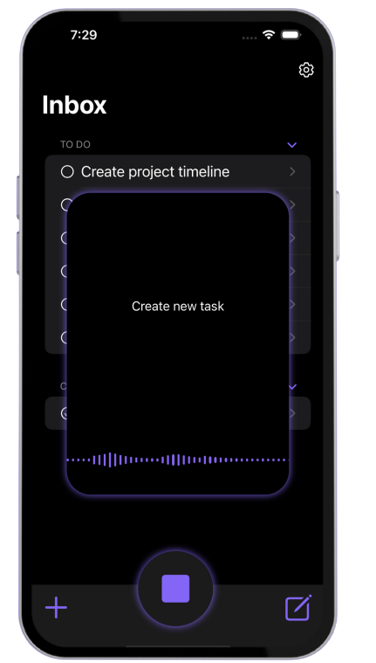
This is where voice capture becomes a genuine superpower. Instead of maintaining a sprawling written task list that grows faster than you can shrink it, open Vozly every morning and speak your three priorities out loud. Speaking them forces a kind of commitment that typing doesn’t. You’ve heard yourself say it. Your brain treats that differently. And because Vozly captures and structures everything you speak, you never lose the things you’ve decided to defer — they’re stored safely, ready for the day when they actually belong on the list.
2. Slow Productivity Requires Protecting Your Best Hours
Every person has a cognitive peak — a window of two to four hours per day when their focus is sharpest, their thinking is clearest, and their output is highest. For most people, this window happens in the morning. For some, it’s mid-afternoon. For others, it’s late at night. The exact timing varies. The existence of the window doesn’t.
Hustle culture ignores this completely. It fills your morning with meetings, your peak hours with administrative tasks, and your creative work with whatever’s left over at the end of the day when you’re running on fumes. The result is that your most important work gets your worst cognitive resources.
Slow productivity inverts this deliberately. Your peak hours are protected. They are not meeting time. They are not email time. They are the hours when you do the work that requires your full brain — the hard thinking, the deep writing, the creative problem-solving that actually moves your most meaningful projects forward.
Before your peak hours begin, open Vozly and speak a single sentence: what is the one thing you’re going to accomplish in this block? Not a list. One thing. The act of voicing that single intention creates a focus anchor that resists interruption far more effectively than a typed note. Your proactive productivity practice starts here — by protecting time before the reactive noise of the day takes over.
3. Slow Productivity Means Working at a Natural Pace
One of the most liberating ideas in slow productivity is that not everything needs to be done urgently. In fact, most things don’t. The urgency we feel around most tasks is manufactured — by notification systems designed to create anxiety, by organizational cultures that reward responsiveness over quality, and by our own internalized belief that faster is always better.
Cal Newport points to the careers of history’s most prolific creators — writers, scientists, composers — and notes that almost none of them worked at what we’d recognize as hustle pace. Darwin took decades to develop his theory of evolution. Newton’s most creative years were spent in forced isolation. The pattern is consistent: deep, meaningful work happens at a pace that allows ideas to develop, connections to form, and quality to emerge. Rushing produces quantity. Patience produces excellence.
For most people, working at a natural pace requires a digital detox from the notification systems that create false urgency. Turning off Slack notifications during focus blocks. Closing email until a designated time. Treating your attention as a resource to be allocated deliberately, not a commons to be accessed by anyone at any moment.
The practical tool here is simple: use Vozly to batch your communication. Speak your responses and action items into the app at designated times — not constantly, not reactively. This one habit alone can reclaim hours of fragmented attention per week and return them to the kind of sustained, uninterrupted focus that slow productivity requires.
4. Slow Productivity and the Power of Single-Tasking
Multitasking is one of the most persistent myths in productivity. Research has consistently shown that what we call multitasking is actually rapid task-switching — and every switch carries a cognitive cost. Attention doesn’t transfer instantly. It leaves a residue. The term for this is attention residue, coined by researcher Sophie Leroy: when you switch from Task A to Task B, part of your attention stays stuck on Task A, reducing the cognitive resources available for Task B.
The result is that multitaskers consistently perform worse on every individual task than people who focus on one thing at a time. They’re busier, but less effective. They feel productive — the flurry of activity is stimulating — but the quality of their output is lower and the time to completion is longer.
Slow productivity prescribes the opposite: single-tasking, deliberately and completely. One task. Full attention. Until it’s done or until the time block ends. Then, and only then, the next thing.
This is another area where voice capture changes the game. When you’re deep in a task and something else surfaces — an idea, a concern, a thing you’ve suddenly remembered you need to do — the old response was to either interrupt yourself to deal with it or try to hold it in working memory while continuing to focus. Neither works. Voice capture offers a third option: speak it into Vozly in five seconds and let your brain release it completely. The thought is safe. It won’t be lost. And you can return to your single task without the mental overload of trying to hold two things at once.
5. Slow Productivity Needs a Weekly Review to Survive
The fifth practice of slow productivity is the one most people skip — and the one that determines whether the whole philosophy holds together over time or quietly collapses back into hustle by default.
A weekly review is a structured pause at the end of every week where you look back at what actually happened, assess whether the week reflected your true priorities, and make deliberate decisions about what next week should look like. It’s the mechanism that prevents slow productivity from being a nice idea you thought about on a Sunday and forgot by Tuesday.
The weekly review also serves a psychological function that’s easy to undervalue. One of the hardest parts of doing fewer things is the ambient guilt — the nagging feeling that you should be doing more, responding to more, pushing harder. A weekly review that shows you clearly what you accomplished, why it mattered, and how it connected to your larger goals is the evidence you need to resist that guilt. You did good work. You can see it. The data is there.
Here’s a simple voice-powered weekly review rhythm that works with slow productivity:
Every Friday, open Vozly and speak through three questions:
What did I actually complete this week? Not what you attempted, not what you started — what did you genuinely finish?
Did my three daily priorities reflect what actually matters most to me? Or did I let other people’s urgencies colonize my most important work?
What one thing would make next week a genuine success — regardless of everything else? Speak the answer. Commit to it out loud. That’s your anchor for the coming week.
This Friday review, done by voice in under ten minutes, is the habit that transforms slow productivity from a concept into a practice.
Slow Productivity and Voice Capture: A Natural Partnership
Here’s something worth naming directly: slow productivity and voice capture are unusually well-matched.
Slow productivity asks you to think carefully about what deserves your attention, protect your best hours, and reduce the friction between intention and action. Voice capture — speaking your tasks, priorities, and observations into an app like Vozly — does exactly that. It’s the lowest-friction task management system that exists. No typing, no formatting, no organizing. Just speak, and the intention is captured.
This matters especially for slow productivity because one of the hidden costs of traditional task management systems is that maintaining them becomes a task in itself. When your to-do app requires fifteen minutes of daily grooming to stay usable, the system is eating the time it was supposed to save. Voice capture eliminates this entirely. You speak when something needs to be captured, and Vozly handles the rest.
The result is a task system that supports slow productivity rather than undermining it — one that captures everything without demanding constant attention, stores your deferred tasks without anxiety, and lets you show up to your peak hours with a clear head and a clear intention.
Final Thoughts on Slow Productivity
Slow productivity isn’t a trend that will peak and fade. It’s a correction — a course adjustment that the data, the burnout statistics, and the lived experience of millions of exhausted people have been demanding for years.
The research is unambiguous: working more hours beyond a certain point doesn’t produce more output. It produces more stress, more errors, more burnout, and eventually, less of everything you were trying to create. The hours you protect for deep, focused, intentional work will almost always outperform twice as many hours of fragmented, reactive, always-on busy work.
This isn’t a permission slip to stop caring. It’s an invitation to care more carefully — about what you work on, when you work on it, and how much of your finite attention you give to things that genuinely deserve it.
Do fewer things. Work at a natural pace. Obsess over quality. Speak your priorities into Vozly before the day’s noise takes over.
That’s it. That’s slow productivity. And it’s enough to change everything about how your days feel.