


You spilled coffee on your shirt right before the 9 AM stand-up. You’re convinced everyone spent the next forty minutes staring at the stain. You could feel the eyes. You rehearsed what you’d say if anyone mentioned it.
Nobody mentioned it. Nobody saw it. Most of them were too busy worrying about their own stand-ups.
This is the spotlight effect — the deeply human tendency to believe that other people are paying far more attention to us than they actually are. It’s the bias that makes you replay that awkward thing you said in a meeting for three days, even though the other person forgot it within seconds. It’s what makes you hesitate to post your work, share an idea, or start something new — because you’re certain the audience is watching, judging, cataloguing every misstep.
They’re not. And understanding why might be the most liberating thing you learn this week.
In this post, we’ll unpack the psychology behind the spotlight effect, look at what the research actually says, and explore how this invisible audience is quietly killing your productivity — and what to do about it.
What Is the Spotlight Effect?
The spotlight effect is a cognitive bias first formally identified by psychologists Thomas Gilovich and Kenneth Savitsky in a landmark 2000 study at Cornell University. Their definition is deceptively simple: we overestimate the extent to which our actions and appearance are noticed and evaluated by others.
In other words, we live as if there’s a spotlight pointed directly at us — bright, unforgiving, catching everything. We assume others catch the hesitation in our voice during a presentation, the error in our email, the typo in our Slack message, the way we mispronounced that word. We carry an invisible camera crew through our lives, narrating our every move for an audience that has largely tuned out.
The irony? Everyone else is doing exactly the same thing. The person across the meeting table isn’t watching you — they’re wondering if you noticed that they said “irregardless” twenty minutes ago.
The spotlight effect operates on a simple false premise: that you are the main character in everyone else’s story. You’re not. You’re a supporting character in theirs — and barely that.
The Research Behind It: You’re Not the Center
The foundational research on the spotlight effect is almost darkly funny in what it reveals.
Gilovich and Savitsky ran a series of studies that became classics in social psychology. In one, they asked participants to walk into a room wearing an embarrassing Barry Manilow t-shirt. Before entering, they were asked to estimate how many of the other people in the room would notice the shirt. Participants consistently overestimated by about 50%.
They thought roughly half the room would register the shirt. In reality, fewer than a quarter did.
A follow-up study extended the finding to performance. Students who gave a poor speech wildly overestimated how negatively their listeners evaluated them. Another experiment showed that people who were caught in moments of social awkwardness — arriving late, stumbling over words — overestimated how much observers would remember the mishap days later.
The pattern held across age groups, cultures, and types of social situations. The spotlight effect appears to be a near-universal feature of human cognition — not a personality quirk, not a sign of anxiety, not something that only happens to self-conscious people. It happens to virtually everyone.
What makes this research particularly relevant for productivity is what happens in work contexts: people delay sharing work, avoid publishing, hold back ideas, and over-rehearse presentations — all because they’re certain the audience is scrutinizing details no one actually registers.
A study published in the Journal of Personality and Social Psychology documented how the spotlight effect scales with self-relevance — meaning the more important something is to you, the brighter the spotlight feels, even though that feeling has no relationship to whether others actually notice.
Why Your Brain Runs This Program
If the spotlight effect is so consistently wrong, why does the brain keep running it?
The answer lies in a concept called egocentric anchoring — our tendency to use our own perspective as the starting point when estimating what others know, see, or think. We know what we’re wearing, what we said, what mistake we just made. That information is vivid and immediate for us. It’s cognitively expensive to fully simulate how little of that information is actually available to someone else.
So we don’t. We assume they see what we see. We anchor on our own experience and adjust for others’ perspectives — but not nearly far enough.
There’s also an evolutionary argument. Paying attention to how we’re perceived by the group was genuinely important for our ancestors. Being ostracized from the tribe was dangerous. So the social monitoring system evolved to be hyperactive — better to over-track social cues than to miss one. In an ancestral environment, the cost of assuming no one noticed your weird behavior (when they actually did) could be higher than the cost of assuming everyone noticed (when they didn’t).
The problem is we’re now running that hyperactive monitoring system in contexts where the stakes are categorically different. Getting the wording slightly off on a work email is not a threat to survival. But the brain treats the social exposure as if it were.
There’s a third mechanism worth naming: the illusion of transparency. A close cousin of the spotlight effect, it’s the tendency to overestimate how visible our inner states are to others. If you feel nervous, you assume others can see your nervousness clearly — when in fact the gap between how nervous you feel and how nervous you appear is typically enormous. Research consistently shows people radiate far less of their internal state than they believe they do.
Together, these three mechanisms — egocentric anchoring, the evolutionary social alarm system, and the illusion of transparency — create a feedback loop that keeps the spotlight burning.
The Spotlight Effect and Perfectionism
The spotlight effect and perfectionism are deeply entangled, and understanding the relationship helps explain why so many people can’t seem to start, finish, or share their work.
Perfectionism, at its root, is often not about high standards. It’s about fear of judgment — specifically, fear that any flaw will be catastrophically visible and catastrophically consequential. The spotlight effect feeds that fear directly. If you believe everyone is watching and evaluating you in high definition, then any imperfection in your work feels like a disaster.
This is why people rewrite emails six times before sending. It’s why they delay publishing a blog post, launching an app, or sharing a design. It’s why the internal monologue is so loud: What if someone notices this is wrong? What if everyone sees I don’t know what I’m doing? What if they judge me for this?
The answer to all three of those questions, according to the research, is: far fewer people than you think, for far less time than you think, with far less intensity than you think.
We wrote about this dynamic in detail in our post on perfectionism fear — how the pursuit of perfect is often really the avoidance of exposure. The spotlight effect is the mechanism underneath: you’re trying to control what an audience sees that isn’t paying the attention you assume.
Recognizing the spotlight effect doesn’t mean becoming sloppy or careless. It means calibrating your concern to reality. The energy spent obsessing over what others might notice — energy that should go into the actual work — gets reclaimed.
How It Kills Productivity Without You Noticing
The spotlight effect is particularly insidious because it doesn’t announce itself as a bias. It presents as reasonable caution, professionalism, or quality control.
Here’s how it typically shows up in daily work life:
Delay disguised as preparation. You’re not ready to share the draft because it still needs work. But what it “needs” is protection from an audience you’ve imagined will inspect it more harshly than they will. The real reason for the delay is the fear of the spotlight, not the state of the draft.
Rehearsal that doesn’t end. You’ve been over the talking points for the meeting thirty times. The meeting is tomorrow. No one in the room will notice the difference between your twenty-third and thirty-first run-through — but the spotlight effect has convinced you they will.
Feedback loops that spiral. You asked a question in a Slack channel that could have been Googled, and now you’re convinced people think you’re incompetent. You replay it. You imagine the comments. The actual event lasted three seconds and nobody thought twice about it.
Avoidance of visibility. You don’t volunteer for the presentation. You don’t reply to the LinkedIn post. You don’t post the article you wrote. Each of these avoidances feels like protection — and each one costs you in compounding ways. Visibility is often a prerequisite for opportunity, and the spotlight effect quietly drains it.
Research on the spotlight effect in workplace contexts — including work from the American Psychological Association on self-presentation anxiety — suggests that performance anxiety rooted in overestimated scrutiny is a significant driver of procrastination, particularly in creative and knowledge work where output is inherently visible and subjective.
The Tetris Effect is worth comparing here: just as the Tetris Effect trains you to see patterns everywhere, the spotlight effect trains you to see audiences everywhere. Both are your brain running a useful pattern that’s been miscalibrated for your actual environment.
Breaking Free: Practical Steps to Dim the Spotlight
Knowing about the spotlight effect cognitively doesn’t automatically fix the feeling. The spotlight still feels real even after you understand it’s not. But there are concrete practices that help recalibrate the system over time.
1. Run the “Will Anyone Remember This?” Test
When you catch yourself agonizing over a potential judgment — a mistake you made, an awkward moment, a piece of work you’re nervous to share — ask yourself: In three days, will anyone remember this? In most cases, the honest answer is no. The brain treats social exposure as if it has a long half-life; research shows it actually decays very quickly for observers, even when it feels permanent to us.
2. Practice “Acceptable Imperfection” in Small Stakes
Deliberately share something imperfect in a low-stakes context. Send a slightly rough draft. Post a thought before it’s fully formed. Reply to an email without triple-checking. The goal is to accumulate evidence against your prediction — to train your system to see that the catastrophic reaction you imagined didn’t materialize. These micro-exposures rewire the threat response over time.
3. Notice When You’re Performing for an Absent Audience
Many of the behaviors the spotlight effect drives — over-rehearsal, endless revision, avoidance of visibility — are performances for an audience that isn’t present and wouldn’t be paying the attention you imagine if they were. Name it when it happens: I’m performing right now. For whom? Often, the answer is: nobody.
4. Redirect Spotlight Energy to the Work Itself
The mental energy spent imagining the audience is energy not spent on the work. When you notice you’re running the spotlight loop — imagining reactions, replaying moments, pre-empting judgments — treat it as a signal to return to the task. What’s the next concrete action? What does the work actually need? This isn’t suppression; it’s redirection.
5. Build an Output System That Captures Momentum
One of the most effective ways to counteract the spotlight effect long-term is to build a habit around shipping — not for the sake of shipping carelessly, but to normalize the act of doing and releasing. The more frequently you complete and share work, the more your brain recalibrates what “done” and “good enough” mean in reality rather than in imagination.
Tools that help you capture tasks, next steps, and ideas while you’re in motion — before the spotlight effect kicks in and freezes you — make a measurable difference.
How Vozly Helps You Stay in the Work, Not Your Head
The spotlight effect is loudest when you stop moving. The moment you step back from the work and start reflecting on how it looks to others is the moment the imagined audience moves in.
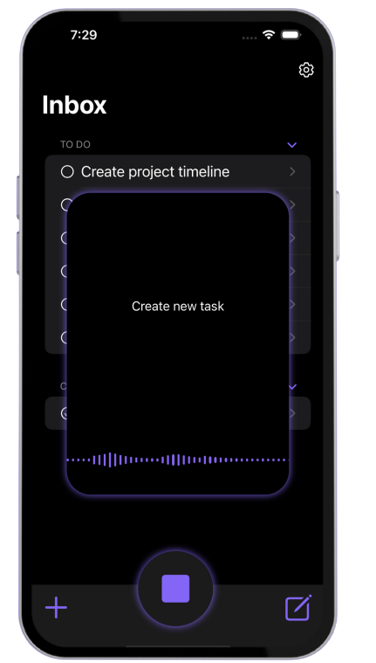
Vozly is a voice-first to-do list app built specifically for the moments when you need to capture a thought and stay in motion — without the friction of typing, switching apps, or interrupting flow. You speak your task, next step, or idea, and it’s captured. You keep moving.
This might sound small. But the spotlight effect often gains its grip precisely in the transition moments — when you lift your head from the work, when you pause, when you switch contexts. Those are the moments when the imagined audience shows up.
Staying in the work, at velocity, reduces the window for the spotlight loop to start. Vozly is designed for that — for the person who thinks faster than they type, who’s in the middle of something and needs to capture without breaking stride.
The goal isn’t to never look up. It’s to choose when you do — and to have something to look at that’s the actual work, not the imagined audience watching it.
We covered a related concept in our post on the Texas Sharpshooter Fallacy — the bias where you retroactively find the pattern after the fact. The spotlight effect works similarly: you build a narrative of scrutiny after the moment passes, and then act as if that narrative was always true.