

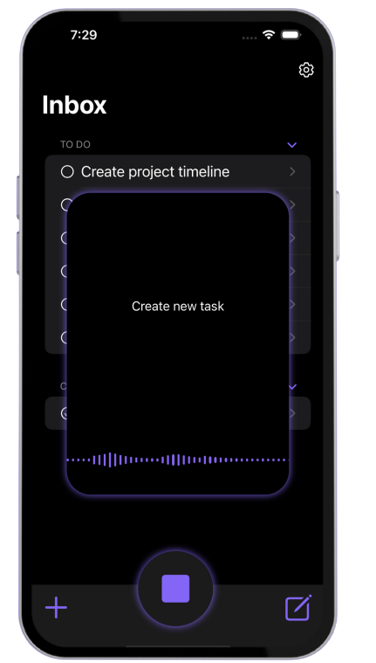

Emotional regulation is one of those phrases that sounds clinical and distant — like something reserved for therapy sessions or psychology textbooks. But here’s the truth: you’ve been practicing it your whole life, just probably without realizing it. Every time you went for a walk to clear your head, turned up the music when you were stressed, or scribbled furiously in a notebook when your brain wouldn’t stop spinning — that was emotional regulation. Your body already knows what it needs. The problem is that most of us have spent years overriding those signals with caffeine, screens, and busyness instead of actually listening to them.
In this post, we’re going to look at 12 body-based techniques for emotional regulation — one for each of the emotional states that show up uninvited and derail your day. And along the way, we’ll show you how capturing your emotional state by voice, before you act, can be the single most powerful regulation tool you already have in your pocket.
Why Emotional Regulation Matters More Than Productivity Hacks
Before we get into the techniques, let’s talk about why emotional regulation belongs in a productivity blog at all.
Here’s the uncomfortable truth: no amount of task management, time blocking, or morning routines will save you if your nervous system is dysregulated. You can have the most beautifully organized to-do list in the world and still be completely unable to act on it when you’re overwhelmed, anxious, or emotionally flooded. In 2026, stress management and emotional regulation are increasingly being treated as skills that can be trained over time — with practices like breathwork, somatic therapies, and nervous system education becoming mainstream tools for everyday mental fitness.
This is the piece that most productivity systems leave out. They assume you arrive at your desk in a neutral, ready-to-work state. Real life doesn’t work that way. Real life serves you stress before breakfast, overthinking at 2 PM, and exhaustion by 4. Emotional regulation is what bridges the gap between how you feel and what you’re actually able to do.
The good news? Somatic work — mindfulness and physical movement techniques that help move difficult emotions through the body — is one of the biggest rising wellness trends of 2026. And the even better news is that many of these techniques take less than five minutes. Your body is faster than your brain at resetting. You just have to give it the right cue.
The Voice Regulation Habit: Speak Before You Act
Before we get into the 12 techniques, there’s one habit worth building first that supercharges all of them: speaking your emotional state out loud before you respond to it.
When you name an emotion verbally — not just think it, but actually say it out loud — something measurable happens in your brain. A landmark study from UCLA found that verbalizing an emotional experience activates the prefrontal cortex and reduces activity in the amygdala, the brain’s alarm center. In plain language: saying “I feel overwhelmed right now” literally calms your nervous system faster than thinking it does.
This is where Vozly becomes more than just a to-do list app. Opening Vozly and speaking a quick voice note about how you’re feeling — before you choose a regulation technique, before you try to push through and work — creates a powerful pause between stimulus and response. That pause is where emotional regulation lives.
Try it the next time you feel one of the 12 states below. Speak first. Then move.
12 Body-Based Emotional Regulation Techniques
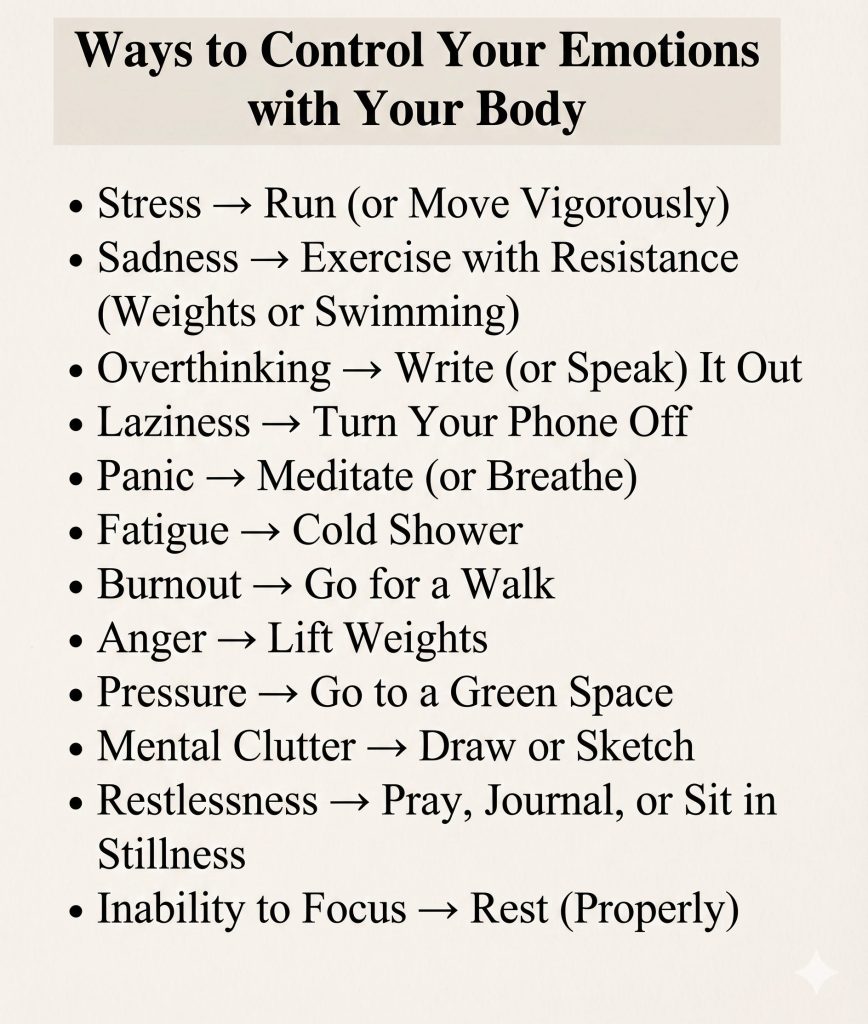
1. Stress → Run (or Move Vigorously)
Stress is your body’s fight-or-flight response — a flood of cortisol and adrenaline designed to help you escape a threat. The problem is that modern stress rarely involves a physical threat, so all that chemical energy has nowhere to go. It just sits in your body, making you tense, scattered, and irritable.
Emotional regulation technique: move vigorously. Run, do jumping jacks, take the stairs fast, do a set of push-ups. Anything that burns through the stress hormones physically. Research consistently shows that even 10 minutes of vigorous movement significantly reduces cortisol levels and improves mood.
Before you lace up, open Vozly and say what’s stressing you. Getting it out of your head and into the app means it won’t be waiting for you when you get back — it’s captured, it’s safe, and your brain can let it go for now.
2. Sadness → Exercise with Resistance (Weights or Swimming)
Sadness has a different physiological signature to stress — it’s slower, heavier, more internal. The emotional regulation technique that works best here isn’t cardio but resistance. Lifting weights or swimming laps gives your body something to push against, which mirrors and then releases the heaviness you’re carrying internally.
There’s also a social facilitation element to this — even going to a gym where other people are working out quietly creates a body doubling effect that gently lifts mood without requiring interaction.
Speak how you’re feeling into Vozly before you go. Sometimes just naming sadness out loud — “I feel low today and I’m not sure why” — is the first step in moving through it rather than around it.
3. Overthinking → Write (or Speak) It Out
Overthinking is your brain trying to solve a problem it doesn’t have enough information to solve yet. It loops because it genuinely doesn’t know where else to go. The emotional regulation technique here isn’t to stop thinking — it’s to externalize the thinking so your brain can finally exhale.
Writing works. But speaking works even faster. Open Vozly and do a full voice brain dump — say every thought that’s spinning, without editing or organizing. Give yourself 90 seconds of completely uncensored verbal output. By the time you’re done, the loop almost always slows down. Your brain feels heard. It stops repeating itself.
This is the voice version of mental overload relief — and it’s one of the most immediate emotional regulation tools available.
4. Laziness → Turn Your Phone Off
What we call laziness is almost never actual laziness. It’s usually one of three things: hidden exhaustion, low dopamine from too much passive scrolling, or decision fatigue from an overwhelming task list. The emotional regulationtechnique here isn’t motivational — it’s environmental. Turn the phone off. Close the tabs. Remove the stimulus that’s keeping your brain in low-engagement mode.
The phone isn’t just a distraction — it’s actively competing with your ability to feel bored, and boredom is actually the precursor to motivation. When you remove the constant low-grade stimulation, your brain naturally starts looking for something to engage with. That something can be your actual work.
Before you put the phone down, use Vozly to speak your one next task. One specific action, out loud. Then close the app and go.
5. Panic → Meditate (or Breathe)
Panic is a full nervous system activation — heart racing, thoughts scattering, body tensing. The fastest emotional regulation response is breath-based, because breathing is the only autonomic function you can consciously control, which means it’s a direct line to your nervous system.
The physiological sigh — a double inhale through the nose followed by a long, slow exhale through the mouth — has been shown in Stanford research to be the fastest single breath pattern for reducing physiological arousal. You don’t need a 20-minute meditation. Two or three of these breaths can measurably shift your state in under a minute.
After breathing, speak a short voice note into Vozly. Name what triggered the panic if you can. Naming it reduces its power — that’s not pop psychology, it’s neuroscience.
6. Fatigue → Cold Shower
Fatigue is a complex state — it can be physical, mental, or emotional, and they all feel slightly different. But the emotional regulation technique that cuts through all three versions is cold water exposure. A cold shower — even just 30 seconds of cold at the end of a normal shower — triggers a norepinephrine release that acts as a natural stimulant, often more effectively than a second cup of coffee.
Cold immersion is now recognized as one of the mainstream emotional regulation and somatic healing practices of 2026, making its way from elite athlete recovery into everyday wellness routines for good reason.
Use Vozly to capture any important tasks or ideas before you step away from your desk. Coming back from a cold shower to a clear voice-captured list means you can re-engage immediately without the re-orientation tax.
7. Burnout → Go for a Walk
Burnout is what happens when you’ve been running on stress hormones for so long that your system has simply run out of fuel. It’s different from tiredness — it’s a deeper depletion that can’t be fixed with a good night’s sleep alone. The emotional regulation technique here isn’t stimulation but gentle restoration.
Walking — especially outside, especially in green space — activates your parasympathetic nervous system, the rest-and-digest mode that burnout suppresses. Wellness microadventures and nature-based movement are among the key mental wellness trends of 2026, helping alleviate the stress and mental fatigue that accumulate from screen-heavy, high-demand modern work.
Even a 15-minute walk without your phone is powerful emotional regulation medicine. Before you go, do a quick Vozly voice note capturing your top priority for when you return. It means your walk is genuinely restorative rather than guilt-ridden.
8. Anger → Lift Weights
Anger generates one of the strongest physiological states of any emotion — elevated heart rate, muscle tension, heightened reactivity. Trying to calm anger with stillness often doesn’t work because the body has energy that needs somewhere to go. The emotional regulation technique that works best is channeling, not suppressing.
Lifting weights — or any high-intensity, resistance-based exercise — gives your anger a physical outlet and a sense of agency and strength that emotionally counteracts the feeling of powerlessness that often underlies anger in the first place.
This is one case where speaking into Vozly before you exercise is especially valuable. Saying what you’re angry about, clearly and out loud, helps prevent the emotion from being redirected toward the wrong people when you come back.
9. Pressure → Go to a Green Space
Pressure is a sustained, ambient stress — the kind that builds slowly and sits on your chest without a clear source you can point to. It responds best not to action but to perspective. Green spaces — parks, gardens, anywhere with trees and sky — have a well-documented effect on perceived pressure and stress. Research into somatic release and nervous system regulation confirms that the body stores tension and pressure physically, and that environmental change — particularly exposure to natural settings — is one of the most effective ways to signal safety to a dysregulated nervous system.
The emotional regulation technique here is simple: leave your environment. Even 10 minutes in a park can measurably shift your cortisol levels and restore a sense of proportion.
Use Vozly to do a quick voice capture of everything that’s pressing on you before you leave. The act of speaking it all out creates a psychological handoff — you’ve given it to the app, so your walk can be genuinely free.
10. Mental Clutter → Draw or Sketch
When your head is so full it feels like static — not overthinking exactly, more like cognitive noise — analytical or verbal approaches to emotional regulation often don’t work. The brain is already overloaded with language and logic. What it needs is a different mode entirely.
Drawing, sketching, or doodling — even with no artistic intent or skill — engages the visual-spatial areas of the brain and gives the verbal, analytical areas a chance to quiet down. You don’t need to draw well. You just need to draw.
After you’ve cleared the static with sketching, open Vozly and speak a quick capture of anything that feels important to hold onto. Visual processing often unlocks ideas and clarity that verbal thinking was blocking.
11. Restlessness → Pray, Journal, or Sit in Stillness
Restlessness is the emotion that most resists being fixed — it’s a generalized sense of unease that can’t be resolved by any specific action because it often doesn’t have a specific cause. The emotional regulation technique here is counterintuitive: instead of moving, you stop.
Prayer, quiet journaling, or simply sitting still without a screen for five minutes creates space for the restlessness to surface and pass naturally. Many people never discover this because they immediately reach for their phone the moment restlessness appears — which numbs it temporarily but doesn’t resolve it.
After a period of stillness, Vozly can help here too. Speaking a reflective voice note — “I’ve been feeling restless this week and I think it’s connected to…” — often surfaces insights that sitting alone couldn’t quite reach. Voice has a way of finishing sentences you didn’t know you were trying to say.
12. Inability to Focus → Rest (Properly)
The final emotional regulation technique is the most countercultural one in a productivity context: when you genuinely can’t focus, the right answer is often to stop working and actually rest. Not scroll. Not switch tasks. Rest.
Rest is no longer optional in 2026 — it’s recognized as core to metabolic health, emotional balance, and resilience. True rest means lying down, sitting quietly, going for a slow walk, or doing something genuinely restorative that doesn’t involve a screen. Twenty minutes of real rest frequently produces more subsequent productivity than two hours of distracted, unfocused work.
Before you rest, use Vozly to speak a quick capture of where you are in your work. “I’m at this point, I need to pick up from here” — a 15-second voice note that means you can come back without the re-entry cost of trying to remember where you were.
How Vozly Fits Into Your Emotional Regulation Practice
There’s a theme running through all 12 of these techniques: speak first, then act.
Not because talking about emotions is the same as processing them — it isn’t. But because the act of naming your emotional state out loud, before you choose your response, creates a critical pause. That pause is the entire game of emotional regulation. It’s the difference between reacting from inside the emotion and responding from a slightly wider perspective.
Vozly makes that pause effortless. Open the app, speak your state, speak your intention, then put the phone down and go do the body-based thing your nervous system is asking for. When you come back, your tasks are captured, your thoughts are stored, and you can re-engage with work from a regulated rather than a reactive state.
This is what a proactive productivity practice actually looks like at the emotional level — not just planning your tasks, but planning your relationship with your own emotional states so they work with your productivity rather than against it.
Final Thoughts on Emotional Regulation
Emotional regulation isn’t about being less emotional. It’s not about pushing feelings aside, powering through, or maintaining a perfectly calm exterior while everything churns underneath. It’s about having a repertoire of responses — body-based, practical, fast — that you can reach for when a particular emotional state arrives.
Your body has been trying to tell you what it needs this whole time. Stress wants to run. Panic wants to breathe. Fatigue wants cold water. Burnout wants a walk. Restlessness wants stillness. These aren’t weaknesses or distractions from your work — they’re the intelligence of a nervous system that knows exactly how to return to balance, if you give it the chance.
The 12 techniques in this post are your starting point. Pick the one that matches how you feel right now. Speak it into Vozly first. Then go let your body do what it already knows how to do.

What is emotional regulation?
Emotional regulation is the ability to recognize, understand, and manage your emotional states in a way that allows you to respond thoughtfully rather than react impulsively. It doesn’t mean suppressing emotions — it means having effective strategies for moving through them in a healthy and timely way, so they don’t derail your relationships, decisions, or productivity.
Why is emotional regulation important for productivity?
When your nervous system is dysregulated — flooded with stress, anxiety, or emotional overwhelm — your prefrontal cortex, the part of the brain responsible for planning, decision-making, and focus, becomes less accessible. No productivity system can compensate for a dysregulated nervous system. Emotional regulation is the foundation that makes all other productivity habits possible.
What are somatic techniques for emotional regulation?
Somatic techniques are body-based approaches to emotional regulation that work by changing your physical state rather than your thoughts. Examples include vigorous exercise for stress, cold water exposure for fatigue, breathing exercises for panic, and walking in nature for burnout. These techniques work because emotions are physiological events, not just mental ones — they live in the body as much as the mind.
How does voice journaling help with emotional regulation?
Speaking your emotional state out loud activates the prefrontal cortex and reduces amygdala activity — the brain’s alarm system. This means that verbally naming an emotion literally calms your nervous system at a physiological level. Voice journaling through an app like Vozly makes this practice fast, low-friction, and available anywhere, turning it into a habit rather than an occasional exercise.