


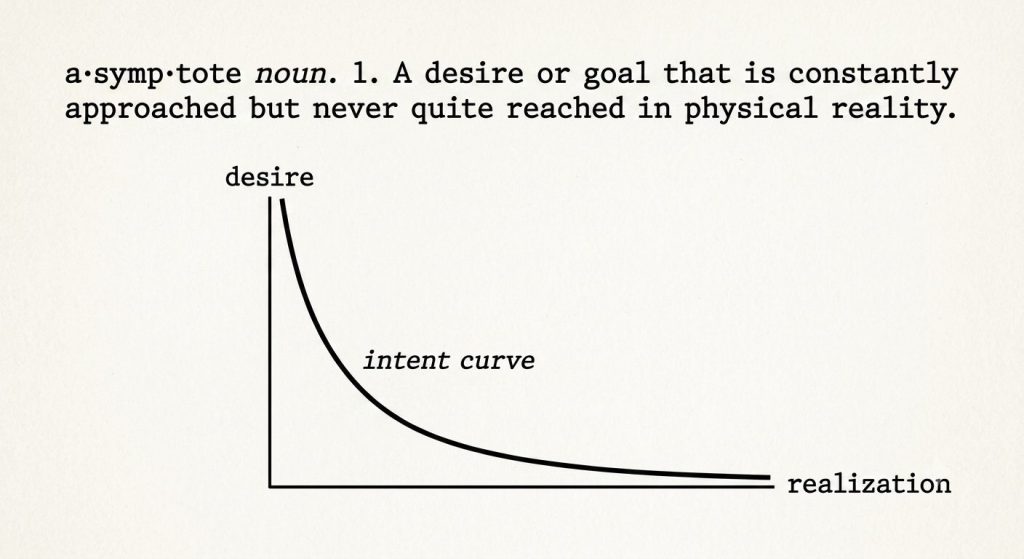
The asymptote effect might be the most accurate mathematical description of the human condition that nobody talks about. In mathematics, an asymptote is a curve that approaches a line forever — getting closer and closer, infinitely — but never actually touching it. Applied to real life, this curve represents desire. The vertical axis is how badly you want something.
The horizontal axis is time passing, realization approaching. And the cruel mathematical truth is that the curve keeps flattening — getting closer to execution, always approaching, never arriving. That’s not just an abstract equation. That’s the business idea you’ve been “almost” starting for six months. The book you’ve been “about to” write. The habit you’ve been “going to” build since January. Desire at its peak — execution perpetually just out of reach.
The good news is that the asymptote effect isn’t a personality flaw or a sign that you lack discipline. It’s a predictable psychological pattern with a clear cause — and once you understand that cause, you can engineer your way out of it.
What Is the Asymptote Effect?
In mathematics, an asymptote describes a curve that continuously approaches a given line but never meets it, no matter how far it extends. Applied to human psychology, the asymptote effect describes the gap between intention and action — the persistent, frustrating distance between how much you want something and how much you actually do about it.
The curve starts vertical. You have a flash of inspiration — a new business idea, a life change you want to make, a goal that suddenly feels urgent and real. In that moment, desire is at its absolute peak. But as time moves along the horizontal axis of realization, the curve flattens. The initial spike of motivation levels off. The idea that felt electric on Sunday night feels manageable but non-urgent by Monday morning, and somewhere between manageable and non-urgent, it quietly never happens.
New research published in Psychological Reports in January 2026 reveals a critical finding: high trait procrastination predicts increased anticipatory anxiety when contemplating goals — and this anxiety effect is most pronounced for short-term goals, meaning the tasks right in front of you trigger the strongest avoidance response. In other words, the closer the execution, the more the curve resists touching the line.
This is the asymptote effect in action. And it affects almost everyone. 88% of the workforce admits to procrastinating for at least one hour during each workday — adding up to over $600 billion in annual lost productivity across the U.S. economy alone.
Why the Curve Flattens: The Psychology of the Asymptote Effect
Understanding why the asymptote effect happens is the first step to breaking it. There are three interlocking psychological forces at work.
The Activation Energy Barrier
In chemistry, activation energy is the minimum energy required to start a reaction. Tasks have a psychological equivalent: the mental effort required to begin feels much greater than the effort to continue. When you experience a burst of inspiration, your desire is vertical — pure, high-voltage intent. But the moment action is required, your brain calculates the cost of beginning: opening an app, writing out a plan, deciding where to start, structuring a task list. The greater the activation energy required, the easier it is to procrastinate. The less energy needed to prepare for a task, the better.
This is the first reason the asymptote curve flattens. The gap between wanting and doing isn’t a gap in desire — it’s a gap in friction. The desire is still there. The activation energy of execution is just slightly higher than the energy available in that moment.
The Zeigarnik Loop
Every unexecuted intention creates an open cognitive loop. Your brain keeps these loops active — quietly running in the background, consuming mental energy, surfacing as vague anxiety and restlessness. This is the Zeigarnik Effect: unfinished tasks stay alive in working memory until they’re either completed or externalized into a reliable system.
The cruel irony of the asymptote effect is that the more open loops you accumulate — the more ideas, intentions, and half-formed plans you carry — the harder it becomes to act on any one of them. The cognitive load of holding everything increases the activation energy of starting anything. The curve flattens faster the more crowded your mental space becomes.
The Intention-Action Gap
Research consistently shows that actually trying something — anything — is about 100% more effective than just thinking about trying something. Yet most goal-setting systems keep us in the thinking phase. We write goals in journals. We create vision boards. We make elaborate plans. All of these activities feel productive because they involve effort, but they don’t close the loop between intention and action. They keep desire alive without accelerating movement toward execution.
The asymptote effect is fed by anything that feels like progress but isn’t action. Planning is not doing. Thinking about doing is not doing. Talking about doing — to yourself, inside your own head — is not doing. But talking out loud, into a system that captures and structures your words? That’s different. That’s where the curve finally starts to move toward the line.
5 Ways to Break the Asymptote Effect with Your Voice
The most powerful insight about the asymptote effect is this: the barrier between desire and execution is almost always a friction problem, not a motivation problem. You don’t need more willpower. You need a lower-friction bridge between the moment of intention and the moment of action. And the lowest-friction bridge available to any human being is their own voice.
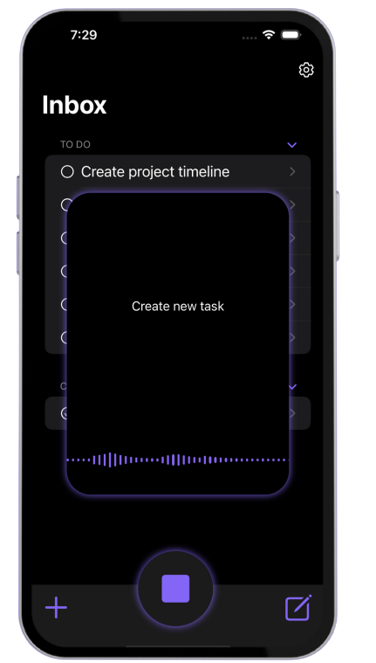
Speaking is faster than typing. It’s faster than writing. It requires zero setup and zero physical preparation. The moment a desire peaks — the moment the curve is at its most vertical — you can speak it into existence before the flattening begins. This is exactly what an app like Vozly is built for: capturing the peak of your intention curve in real time, before the asymptote effect flattens it into another unfulfilled approach.
Here are five specific strategies to break the pattern.
1. Capture at Peak: Speak the Moment Desire Spikes
The asymptote effect is most powerful in the gap between inspiration and capture. That gap — even if it’s just a few hours — is where most ideas go to die. The moment you think “I should really do X,” that’s the vertical point of your curve. Five minutes later, the curve has already started to flatten.
The fix is immediate capture by voice. The moment a desire, idea, or intention surfaces — regardless of where you are or what you’re doing — open Vozly and speak it out loud. Not a note to yourself. Not a mental bookmark. A spoken, captured, externalized commitment that now lives outside your head in a reliable system.
Breaking tasks into micro-steps removes activation energy barriers and enables natural momentum once started.So when you speak your intention into Vozly, be specific about the first physical action — not the big goal, but the very next step. Not “start the business,” but “research three competitors and speak the findings into Vozly by Thursday.” The more specific the first step, the lower the activation energy, and the less room the asymptote effect has to operate.
2. Speak the Micro-Action, Not the Macro-Goal
One of the main reasons the asymptote effect is so persistent is that we tend to store goals at the wrong level of resolution. “Launch the podcast.” “Get fit.” “Learn Spanish.” These are destinations, not actions — and the brain can’t execute a destination. It can only execute a next step.
When you speak a goal into Vozly, train yourself to immediately follow it with the smallest possible physical action. “I want to start a podcast” becomes “Record a 3-minute test episode this evening just to hear my own voice — no editing, no publishing.” “Get fit” becomes “Put gym shoes by the front door tonight.” “Learn Spanish” becomes “Open Duolingo for five minutes before coffee tomorrow morning.”
The asymptote effect thrives on vagueness. Specificity is its antidote. And because speaking is so fast and low-friction, you can capture both the desire and the micro-action in the same 15-second voice note — before the curve has time to flatten.
3. Use Auditory Commitment to Raise the Stakes
There’s a neurological reason why spoken commitments feel different from written ones. When you hear your own voice stating an intention, your brain processes it as a social signal — similar to telling someone else what you’re going to do. 78% of workers admit to feeling anxious when they procrastinate, yet continue to do so.The anxiety is already there. Auditory commitment redirects that anxiety productively — instead of anxiety about not doing something, you create a mild social pressure to follow through on what you’ve said.
This is why speaking your tasks into Vozly works differently from typing them. The voice carries the weight of the commitment. You’ve heard yourself say it. That matters to your brain in a way that a typed note often doesn’t. The curve of the asymptote effect is pushed closer to the execution line every time you make a spoken rather than a silent commitment.
4. Clear the Cognitive Stack with a Voice Brain Dump
If the asymptote effect is partially driven by cognitive overload — too many open loops competing for execution bandwidth — then the single most effective intervention is a complete cognitive offload. Once a day, ideally at the start of your morning or the end of your workday, open Vozly and speak every open loop in your head.
Every task. Every worry. Every intention. Every half-formed idea. Every thing you’ve been meaning to do. Speak it all, without filtering or prioritizing, until your mental stack feels empty. Vozly captures and transcribes everything, which means your brain can finally close those loops — not because they’re done, but because they’re safe. They’re in a system. They don’t need to be held anymore.
This is your Second Brain operating at its most fundamental level. When your cognitive stack is clear, the activation energy of starting any single task drops dramatically — because your brain isn’t simultaneously trying to hold forty other things. The asymptote effect weakens significantly when the mental load it feeds on is reduced.
5. Build a Proactive Voice Ritual to Outrun the Flatten
The asymptote effect operates on a time delay. The initial spike of desire is always followed — inevitably — by a gradual flattening. The way to beat this isn’t to fight the flattening; it’s to act before it happens, every single time, with a consistent ritual.
A proactive productivity voice ritual means that at the same time every day — before the reactive noise of notifications, messages, and other people’s agendas takes over — you open Vozly and speak your three most important intentions for the day. Not a full task list. Just three. The three things that, if spoken and committed to before the day’s friction begins, have a fighting chance of actually happening.
This ritual works because it catches the curve before it flattens. The first moments of your day — before email, before social media, before the world’s demands arrive — are when your desire curve is still relatively steep. Speaking your intentions then is like drawing a line directly toward execution before the asymptote effect has time to pull the curve away.
The Asymptote Effect and Social Architecture
There’s a social dimension to the asymptote effect that’s easy to overlook. When we keep our desires internal — hidden in our heads, written only in private journals — we remove the social accountability that helps close the intention-action gap. Human beings are wired for social commitment. We follow through more reliably when others are aware of our intentions.
Voice capture adds a layer of this social dynamic even in solitude. Speaking a commitment out loud — even to an app — activates the same neural pathways as telling another person. It externalizes the intention. It gives it weight. And over time, building a habit of speaking your plans before the asymptote effect can flatten them creates a fundamentally different relationship with your own goals: one where the distance between desire and execution gradually, consistently, closes.
Final Thoughts: Stop Approaching, Start Arriving
The mathematical tragedy of the asymptote is real. The curve never touches the line — infinitely close, perpetually out of reach. But mathematics describes what happens without intervention. Human beings can intervene.
The asymptote effect flattens your desire curve through friction, cognitive overload, and the slow decay of uninternalized intention. You can fight back on all three fronts: reduce friction by using your voice, clear cognitive overload with daily brain dumps, and externalize intentions through auditory commitment before the flattening begins.
You are not a curve doomed to approach but never arrive. You are someone with a voice, a system, and the knowledge of exactly why the gap exists. That’s enough to close it.
Download Vozly, speak your most important intention right now — before you close this tab, before the curve starts to flatten — and watch the distance between desire and execution finally begin to shrink.