
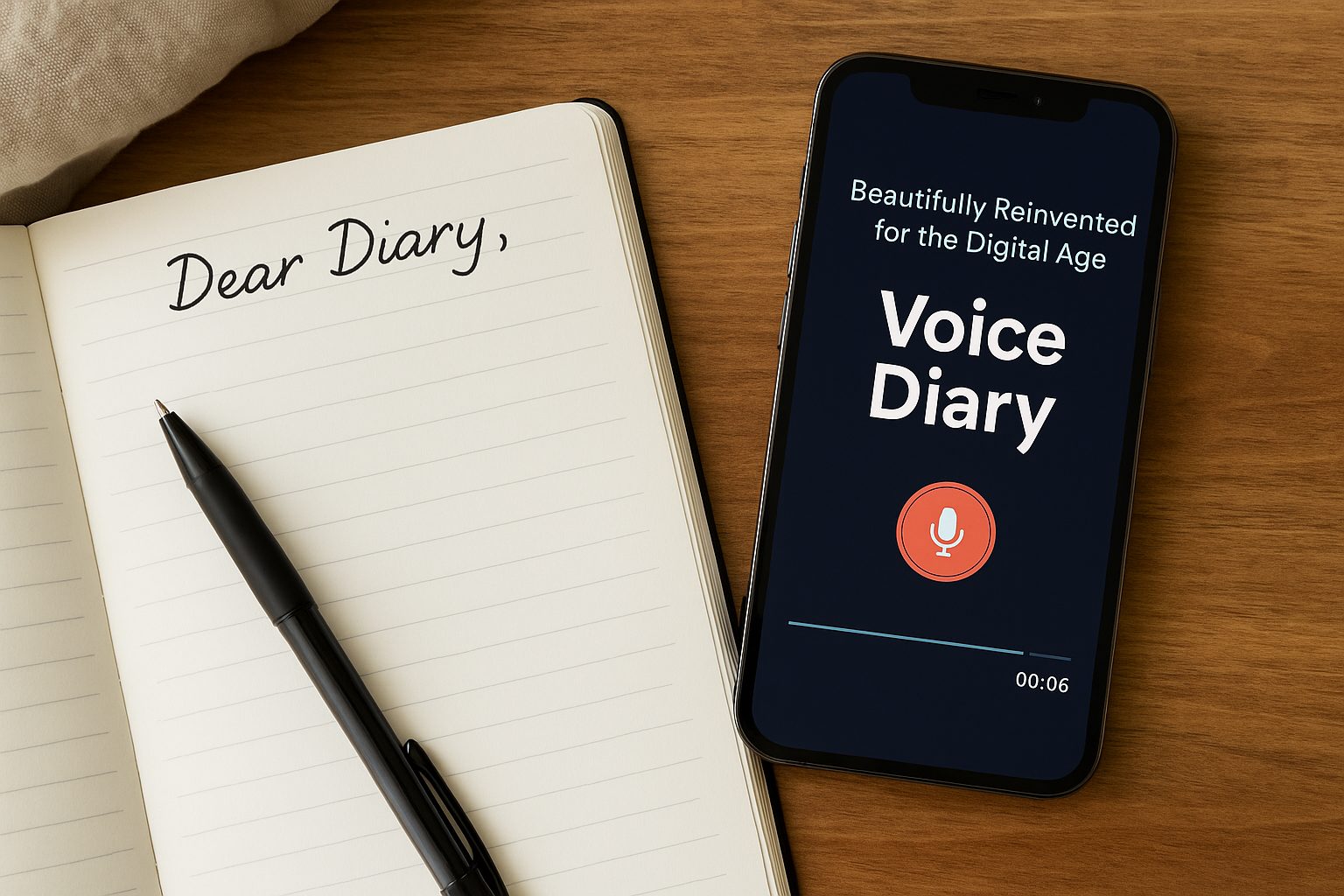

Voice diary — a modern way to capture your day before it fades.
Dear Diary,
Today was one of those long, unpredictable days — full of small moments that felt bigger than they looked. I met new people, got lost in my thoughts, laughed at something silly, and for a second, almost cried over an old memory. And now, as I finally sit down, pen in hand, I think to myself: where do I even start?
There’s always been something magical about writing — the sound of a pen gliding over paper, the way words somehow make sense of chaos. But tonight, I’m too tired to write it all down. My hand hesitates, yet my mind is bursting with thoughts I don’t want to forget. Maybe it would be easier if I could just say them.
That’s where the voice diary comes in — a modern twist on the classic “Dear Diary.” Instead of scribbling words that might never capture the full emotion, you simply speak. You record your day, your feelings, your fleeting thoughts — exactly as they sound in your head. It’s personal, immediate, and real.
With tools like Vozly, you can keep a voice diary that grows with you — one that doesn’t just preserve your words, but your tone, your pauses, even your laughter. Because sometimes, the way you say something says more than the words themselves.
So tonight, I put the pen down and picked up my phone. I pressed record, took a deep breath, and began:
“Dear Diary… today was a lot.”
Maybe that’s what modern journaling is all about — not just remembering what happened, but hearing how it felt.
If you enjoyed exploring the art of voice journaling, you might also like our post on Record Your Dreams — a guide to capturing the stories your mind tells in sleep.
The Psychology of Voice Journaling
There’s something profoundly human about speaking your thoughts aloud. When you write in a diary, your brain filters — it edits, refines, and translates raw emotions into tidy sentences. But when you keep a voice diary, you speak before you censor. You capture truth in its purest form — tone, breath, hesitation, emotion.
Psychologists say that verbal expression activates deeper emotional processing. When you talk through an experience — instead of only writing about it — you engage both cognitive and emotional centers of the brain. That’s why voice journaling often feels more honest, more freeing. It’s not just storytelling; it’s self-therapy in real time.
Keeping a voice diary also helps you notice emotional patterns you might miss on paper. The sound of your own voice becomes data — you can hear stress, joy, calm, or fatigue even when your words don’t say it outright. Over time, that awareness strengthens emotional intelligence and resilience.
And there’s something magical about hearing your past self. Listening to an old entry — your younger voice, your laughter, your trembling tone — reminds you how far you’ve come. A voice diary isn’t just a log of events; it’s a timeline of growth, healing, and self-discovery.
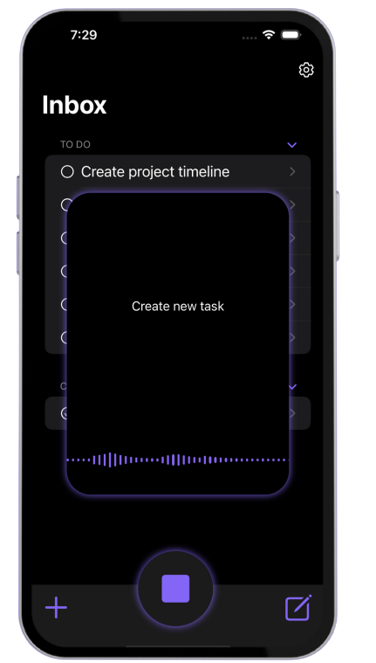
Apps like Vozly take this even further by making the process effortless. Just tap and talk — no pressure to be poetic or perfect. The simplicity invites honesty, and that honesty becomes clarity.
Because in a world full of digital noise, the most powerful thing you can listen to… is yourself.
Why Voice Journals Matter in the Digital Age
We live in an age where everything is recorded — photos, messages, voice notes, even our heart rate. Yet somehow, what’s real often gets lost between notifications and endless scrolling. That’s why a voice diary feels like a quiet rebellion — a space where your voice, not the algorithm, takes the lead.
Unlike social media, a voice diary isn’t about performing for others. It’s about belonging to yourself. It’s a space without filters, likes, or judgments — a digital sanctuary for raw, unedited thought. You’re not talking to an audience; you’re talking to your own awareness.
And in this hyper-digital world, that’s more radical than it sounds. Because speaking your truth aloud trains your brain to slow down. It brings mindfulness into the noise, helping you reconnect with emotion instead of distraction.
With Vozly, this process becomes effortless — you don’t have to open a notebook or stare at a blinking cursor. Just press record, talk for a minute, and save your inner world in sound. It’s like therapy in your pocket — immediate, personal, and deeply human.
Over time, your voice diary becomes more than just an archive; it becomes a mirror. Listening back, you hear how your confidence grows, how your tone shifts, how your perspective changes. It’s the sound of personal evolution — one that text could never fully capture.
Because words written may fade, but your voice — your tone, your laughter, your truth — remains unmistakably yours.
The Takeaway: Speaking Your Truth Out Loud
At the end of the day, your voice carries what words alone cannot — energy, emotion, and truth. A voice diary isn’t just a tool for remembering your days; it’s a way of hearing your life as it unfolds.
Some nights, you might whisper into your phone half asleep, uncertain if it even matters. But months later, when you play it back, you’ll hear something remarkable — growth, tenderness, strength you didn’t know you had.
That’s the quiet magic of keeping a voice diary. It doesn’t demand perfection. It simply asks for presence. It invites you to speak, to reflect, to connect — not with the world, but with yourself.
In a society obsessed with capturing moments for others, a voice diary is a reminder to capture them for you.
So tonight, when the world goes silent and the day finally exhales, take a breath and say it out loud:
“Dear Diary…”
Because sometimes, the most powerful story you’ll ever tell — is the one you tell yourself.