

Voice-based productivity habits are intentional, repeatable routines that use spoken language and voice-first technology to capture tasks, manage priorities, and organize your day — entirely hands-free. Instead of stopping what you are doing to type a note, open an app, or navigate a menu, you simply speak. The system listens, transcribes, and organizes. When these micro-habits are stacked consistently throughout the day, they create a seamless, low-friction productivity system that frees your mental energy for the work that actually matters.
If you have ever had a brilliant idea in the shower, during your commute, or in the middle of a conversation — and then completely forgotten it by the time you reached your desk — you already understand the core problem that voice-based productivity solves. Our best thinking does not always happen when we are sitting in front of a keyboard. But our best tools have historically been designed as if it does.
That is changing rapidly. In 2026, voice-first technology is no longer a novelty. It is a serious productivity infrastructure. In this guide, we will break down the 7 most impactful voice-based productivity habits, explain the psychology behind why they work, and show you exactly how to build them into your daily routine using Vozly.
This is why voice-based productivity habits are the smartest upgrade you can make to your workflow.
Why Voice-Based Productivity Habits Actually Work
Before we dive into the specific voice-based productivity habits on this list, it is worth understanding the psychological and neurological reasons why speaking is so much more powerful than typing for productivity.
The Cognitive Load Argument
Typing requires a context switch. When a thought pops into your head and you need to record it, you have to: unlock your phone, find the right app, navigate to the input field, type out the thought (often making errors), and correct them. By the time you are done, the original thought has already lost its urgency and emotional charge. Sometimes you have even forgotten the nuance of what you wanted to capture.
Speaking eliminates every single one of those steps. You open your app, you talk, you are done. This is not just faster — it is a fundamentally different cognitive experience. You are working with your brain’s natural output mechanism, not against it.
The Speed Advantage
The average person types at around 40 words per minute. The average person speaks at around 130 words per minute. That is more than three times faster. For productivity purposes, this means you can capture a complete thought — with full context, nuance, and detail — in the time it would have taken you to type just the headline.
The Consistency Factor
The greatest productivity system in the world is useless if you do not use it consistently. Voice-based productivity habits have a dramatically higher adoption rate than typing-based ones because the friction is so low. When something is easy, you do it. When something is hard, you procrastinate. Voice input is easy.
7 Voice-Based Productivity Habits to Build Right Now
1. The Morning Brain Dump (Before You Check Your Phone)
The first and most powerful voice-based productivity habit is a morning brain dump, performed before you look at your email, your messages, or your social media feeds. Of all the voice-based productivity habits in this guide, this one sets the tone for everything that follows.
Here is how it works: within the first five minutes of waking up — ideally before you have fully engaged with the outside world — you open your voice app and speak every thought, task, worry, and intention that is in your head. You are not organizing. You are not prioritizing. You are simply emptying your mental RAM.
This habit is rooted in a well-established psychological concept. When the brain wakes up, it enters a state of hypnopompia — the transitional state between sleep and wakefulness — where the prefrontal cortex is not yet fully engaged. Your subconscious mind is still very active during this window, and it often surfaces important insights, creative ideas, and unresolved concerns that your conscious, logical mind tends to suppress during the day.
By capturing this raw mental output with your voice, you accomplish two things. First, you clear your working memory, giving yourself a clean mental slate to start the day with focus. Second, you often discover hidden priorities — things that are genuinely important to you that would never surface during a structured planning session.
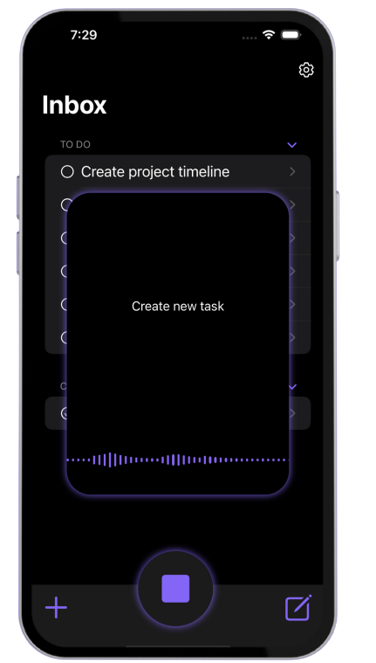
With Vozly: Open Vozly the moment you wake up and use voice-to-task to speak every item that comes to mind. Vozly transcribes each one into a structured to-do item instantly, meaning your morning dump becomes a ready-to-prioritize task list by the time you finish your first cup of coffee.
2. The Voice-First Task Capture (Capture Everywhere, Anytime)
The second habit is arguably the most impactful for day-to-day productivity: committing to voice-first task capture as your default input method, regardless of where you are or what you are doing.
This means that any time a task, idea, commitment, or deadline enters your awareness — whether you are driving, cooking, walking, or in between meetings — your first instinct is to speak it into your voice app rather than try to remember it or make a mental note.
The danger of mental notes is not that they are unreliable (though they are). The deeper danger is the cognitive overhead of trying to hold them. Every unrecorded task sits in the back of your mind, quietly consuming mental energy as your brain repeatedly cycles back to it to make sure you have not forgotten. Psychologists call this the Zeigarnik Effect: unfinished tasks create a persistent loop of background cognitive activity.
Voice-first task capture closes those loops instantly. The moment you speak a task into your app, your brain can release it completely. The result is a measurable increase in mental clarity and focus.
With Vozly: Vozly’s voice-to-task feature was built specifically for this habit. Say the task out loud, and it is captured, transcribed, and added to your list in seconds. No typing, no navigating menus, no friction.
3. The Eisenhower Voice Sort (Prioritize While You Commute)
Capturing tasks is only half the equation. The other half is knowing which ones to actually do. This is where the Eisenhower Matrix becomes an essential companion to your voice habits.
The Eisenhower Matrix divides tasks into four quadrants based on two dimensions: urgency and importance. Tasks that are both urgent and important get done immediately. Tasks that are important but not urgent get scheduled. Tasks that are urgent but not important get delegated. Tasks that are neither get eliminated.
The voice-based version of this habit involves doing your Eisenhower sort out loud, ideally during a commute or a short walk. Instead of staring at a written matrix and mentally categorizing items, you speak through your task list and verbally assign each one to a quadrant: “Reply to client email — urgent and important, do today. Research new marketing strategies — important, not urgent, schedule for Thursday. Order office supplies — urgent, not important, delegate to assistant.”
Doing this aloud has a powerful cognitive benefit: the act of speaking forces you to actually commit to a decision. When we categorize silently in our heads, it is easy to remain vague and avoid the discomfort of real prioritization. When we say it out loud, the decision feels real. We are accountable to the words we have spoken.
With Vozly: Use Vozly’s built-in Eisenhower Matrix feature to sort your tasks directly within the app. After your voice capture session, review your list and drag tasks into the correct quadrant — or simply speak your sorting decisions as new voice notes attached to each task.
4. The Pomodoro Voice Anchor (Set Your Focus Intervals Out Loud)
The Pomodoro Technique — working in focused 25-minute blocks separated by short breaks — is one of the most evidence-backed productivity methods in existence. But one of its most common failure points is the transition into focus mode. We set a timer, but we do not mentally commit to the session. We are physically present but mentally scattered.
A voice anchor solves this. Before starting each Pomodoro block, you speak your intention out loud: “For the next 25 minutes, I am going to write the first draft of the project proposal. Nothing else.” This is not motivational theater. It is a cognitive priming technique. By articulating your focus intention verbally, you activate the language processing centers of your brain and create a much stronger behavioral commitment than simply thinking the intention silently.
The science behind this is clear: implementation intentions — specific plans that state what you will do, when, and how — dramatically increase follow-through rates compared to vague goal-setting. Adding a vocal component makes the commitment even more concrete.
After the Pomodoro block ends, use your voice to do a brief review: “I finished the first draft intro section. Next block: complete the main arguments section.” This creates a chain of accountability that keeps your momentum going across multiple focus sessions.
With Vozly: Use Vozly’s integrated Pomodoro timer alongside its voice note feature. Set your timer, speak your focus intention as a voice note, and then let Vozly track your session.
When the timer ends, record your progress update with your voice before starting the next block.
5. The Voice Dream Log (Capture Subconscious Insights)
This habit might seem unusual in a productivity context, but the evidence for its value is compelling. Dreams are one of the primary mechanisms through which the brain processes unresolved problems, integrates new information, and generates novel connections between disparate ideas. Many of history’s most creative breakthroughs — from scientific discoveries to artistic innovations — have been attributed to dream-state insights.
The challenge is that dream memories are extraordinarily fragile. Research suggests that within five minutes of waking, approximately 50% of dream content is forgotten. Within ten minutes, that number rises to 90%. The window for capture is incredibly small.
This is where a voice dream log becomes invaluable. By keeping your voice app accessible on your nightstand, you can capture dream content in the first seconds of waking — before the critical, analytical left brain takes over and begins suppressing the associative, imagistic content of your dreams. Speaking is far faster than writing during this groggy transition period, making it the ideal capture method.
Over time, your dream log becomes a rich archive of subconscious insights. You may notice recurring themes that point to unresolved concerns, creative patterns that inform your work, or specific ideas that turn out to be surprisingly useful when reviewed with fresh eyes during the day.
With Vozly: Vozly includes a dedicated Dream Log feature designed exactly for this habit. Keep Vozly open on your nightstand and speak your dreams the moment you wake up. Vozly transcribes everything instantly, creating a searchable archive of your subconscious insights.
6. The End-of-Day Voice Review (Close the Loop on Every Task)
One of the most underrated productivity habits is the end-of-day review — a deliberate, structured process of closing out the workday by reviewing what was accomplished, what remains undone, and what needs to carry forward to tomorrow.
Most people skip this habit entirely because it feels like administrative overhead at the end of an already exhausting day. A voice-based version removes this barrier almost completely, making it one of the most sustainable voice-based productivity habits you can build. Instead of opening a planner and manually updating task statuses, you simply speak your review out loud in three to five minutes.
The structure is simple. First, you speak your wins: tasks completed, progress made, problems solved. This is not just positive affirmation — research on the “progress principle” shows that consciously acknowledging daily progress is one of the most powerful drivers of sustained motivation and engagement. Second, you speak your open loops: tasks that started but did not finish, commitments made to others, items that need follow-up. Third, you speak your top three priorities for tomorrow.
By verbalizing tomorrow’s priorities the evening before, you engage a psychological phenomenon known as the intention effect. Your brain continues to process these priorities during sleep, priming your neural networks to recognize relevant information and opportunities when you wake up the next morning.
With Vozly: Use Vozly’s voice notes feature to record your end-of-day review as a three-part spoken memo. Then, use voice-to-task to immediately capture tomorrow’s top priorities as new to-do items. You close the day clean and wake up with a clear, pre-loaded agenda.
7. The On-the-Go Idea Capture (Never Lose a Thought Again)
The final voice-based productivity habit is the one that ties all the others together: a zero-tolerance policy for lost ideas. This means committing to the principle that no good thought — no creative insight, no process improvement idea, no potential solution to a problem — is ever allowed to float away uncaptured.
The practical implementation is simple but requires a genuine behavioral shift. Any time an interesting thought surfaces — during a conversation, while exercising, while cooking dinner, while waiting in line — you immediately reach for your voice app and speak it into existence. You do not tell yourself you will remember it later. You do not wait until you are at your desk. You capture it now.
The compounding effect of this habit is staggering. Most people let dozens of valuable ideas pass through their minds every day, only to be lost because the capture mechanism was too inconvenient. Over months and years, this represents an enormous loss of intellectual capital. A voice-first tool eliminates this loss entirely.
With Vozly: Whether you are recording a quick task, a longer voice note, or a spontaneous creative idea, Vozly is designed to be the fastest possible path from thought to captured text. The interface is intentionally minimal so that you can open the app and start speaking within seconds, no matter where you are.
Building Your Voice Productivity Stack: How to Start
Changing your productivity habits is not about willpower — it is about system design. Here is a simple three-week ramp-up plan to integrate voice-based habits without overwhelming yourself:
Week 1 — Foundation: Focus only on Habit 2 (voice-first task capture). Every time you think of a task, speak it into Vozly. Do not worry about organization or prioritization yet. Just build the capture reflex.
Week 2 — Structure: Add Habit 1 (morning brain dump) and Habit 6 (end-of-day review). You now have voice bookmarks on both ends of your day, with continuous capture in the middle.
Week 3 — Optimization: Add Habits 3, 4, 5, and 7 progressively. By the end of week three, your entire daily productivity workflow is voice-powered and running on autopilot.
The key is to resist the temptation to implement everything at once. Behavioral research consistently shows that habit stacking — building one habit at a time and then adding the next — produces far higher long-term adoption rates than trying to overhaul everything simultaneously.

Frequently Asked Questions
What are voice-based productivity habits?
Voice-based productivity habits are intentional, repeatable routines that use voice input and voice-first apps to capture tasks, prioritize work, and organize the day without typing. They leverage the speed and naturalness of speech to reduce friction and increase consistency in your productivity system.
Is speaking tasks out loud actually faster than typing?
Yes, significantly. The average person speaks at roughly 130 words per minute, compared to 40 words per minute for typing. For productivity purposes, this means you can capture a fully detailed thought in the time it takes to type a brief headline, which dramatically increases both the speed and the quality of your task capture.
How does Vozly support voice-based productivity habits?
Vozly is a voice-first productivity app that supports all seven habits described in this guide. It offers voice-to-task creation, voice notes, a dedicated Dream Log, an Eisenhower Matrix for priority sorting, and an integrated Pomodoro timer — all accessible through a minimal, fast interface designed to minimize the time between having a thought and capturing it.
Can voice habits replace traditional to-do list apps?
Voice habits do not replace the structure of a to-do list — they power it. The best approach is to use voice as your primary input method and a structured app like Vozly as your organizational system. You speak, the app organizes. This combination gives you the best of both: the speed and naturalness of voice with the clarity and structure of a well-designed task management system.
How long does it take to build a voice productivity habit?
Research suggests that new habits take between 18 and 66 days to become automatic, depending on their complexity and how consistently they are practiced. The three-week ramp-up plan described in this guide is designed to build a solid foundation within the lower end of that range, particularly because voice-based productivity habits have unusually low friction and are therefore adopted faster than most behavioral changes.