Sleep productivity is the most misunderstood concept in modern health and performance — and it might be quietly destroying your energy every single night.
You’re not tired because you’re busy. You’re tired because of what you’re doing in the last 90 minutes before bed. Most people think sleep productivity simply means getting eight hours. But research tells a very different story: it’s not how long you sleep — it’s how well your body and brain are prepared to sleep, recover, and wake up ready to perform.
The painful truth is that millions of people follow what they believe are perfectly normal evening routines — and those routines are actively working against them. Not because of one dramatic bad habit, but because of seven small, invisible ones that compound night after night.
73%of adults report feeling unrested despite sleeping 7–8 hours — meaning the problem isn’t the hours. It’s what happens before, during, and after sleep that determines whether your energy is actually restored. — American Sleep Association, 2024
In this guide, you’ll discover the seven habits most secretly destroying your sleep productivity — and a practical system for fixing each one, starting tonight. You’ll also see exactly how Vozly can become your nightly wind-down companion, turning your racing end-of-day mind into organized calm.
WHY SLEEP PRODUCTIVITY IS A SYSTEM, NOT A SINGLE FIX
Before diving into the habits, it helps to understand what sleep productivity actually means at a biological level. Sleep is not passive rest. It’s an active restoration process in which your brain flushes toxins, consolidates memories, regulates hormones, and repairs cellular damage. When this process is disrupted — even partially — the effects on next-day cognitive performance are immediate and measurable.
The science: Research from the Sleep Foundation shows that a single night of disrupted sleep reduces working memory capacity by up to 40% and decreases emotional regulation by 60%. Over time, chronic poor sleep productivity has been linked to reduced creativity, impaired decision-making, and a 33% drop in daily task completion rates.
The good news: you don’t need a full sleep overhaul. You need to identify which of the seven habits below apply to you — and fix those specific ones. Most people need to change just two or three habits to see a dramatic improvement in their energy and focus.
The Late-Night Screen Spiral — How It Silently Kills Sleep Productivity
It starts innocently. You check your phone to set an alarm. Then there’s one notification, one email, one short video. Forty-five minutes later, you’re watching a debate about something you don’t care about, wide awake, convinced you’ll fall asleep “in a minute.”
This is the Late-Night Screen Spiral, and it’s the single most damaging habit for sleep productivity because it attacks on three fronts simultaneously: it exposes your eyes to blue light that suppresses melatonin production, it triggers the dopamine system that keeps your brain seeking stimulation, and it fills your working memory with new information your brain then tries to process during the first sleep cycles — the ones responsible for physical restoration.
Research finding: A Harvard Medical School study found that exposure to blue light from screens in the 90 minutes before bed suppresses melatonin for up to 3 hours — effectively delaying your biological sleep clock by the same amount, regardless of what time you get into bed.
The fix — The 3-Stop Rule: Set a phone alarm called “Screen Stop” for 90 minutes before your target sleep time. When it goes off, you have three permitted screen interactions: check any truly urgent messages, set tomorrow’s alarm, and open Vozly to do a 3-minute voice brain dump of everything on your mind. After that, the phone goes face-down and silent.
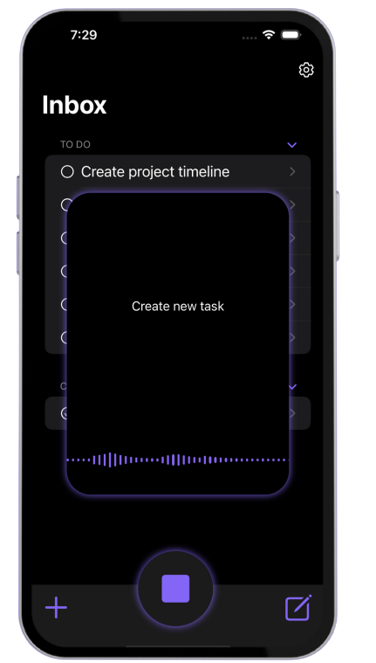
Use Vozly’s night mode for your pre-sleep brain dump. Speak everything that’s swirling in your head — tomorrow’s tasks, worries, ideas, unfinished business. When it’s captured in Vozly, your brain stops trying to hold it. This is one of the most powerful sleep productivity hacks that takes less than 3 minutes.
HABIT TWO
Irregular Sleep Timing Destroys Your Circadian Rhythm
Your body runs on a biological clock — the circadian rhythm — that governs hormone release, body temperature, and alertness across a 24-hour cycle. This clock is remarkably precise, but it’s also remarkably sensitive to inconsistency. When you go to bed at 10pm on Monday and 1am on Friday, you are essentially giving yourself social jetlag every single week.
The consequences for sleep productivity are severe. Irregular sleep schedules have been shown to produce the same next-day cognitive impairment as staying up 24 hours straight — because your body’s restoration processes are timed to specific windows in the night cycle. When those windows shift, the restoration still happens — just at the wrong time, often when you’re trying to be awake and functional.
THE WEEKEND LIE-IN TRAP
Sleeping in by more than 90 minutes on weekends resets your circadian rhythm enough to cause Sunday night insomnia — which then leads to a tired Monday, which leads to caffeine overuse, which leads to poor sleep Tuesday… This is the productivity death spiral most people never connect to their sleep habits.
The fix: Choose a wake time — not a sleep time. Your wake time is the anchor. Set it and protect it seven days a week. Your body will naturally align your sleep time within two weeks, and your sleep productivity will improve measurably even before you change anything else.
“The most dangerous sleep habit isn’t staying up late. It’s staying up late differently every night — and wondering why your body never knows what to expect.”
HABIT THREE
The Unfinished Thought Problem — The Real Reason Sleep Productivity Suffers
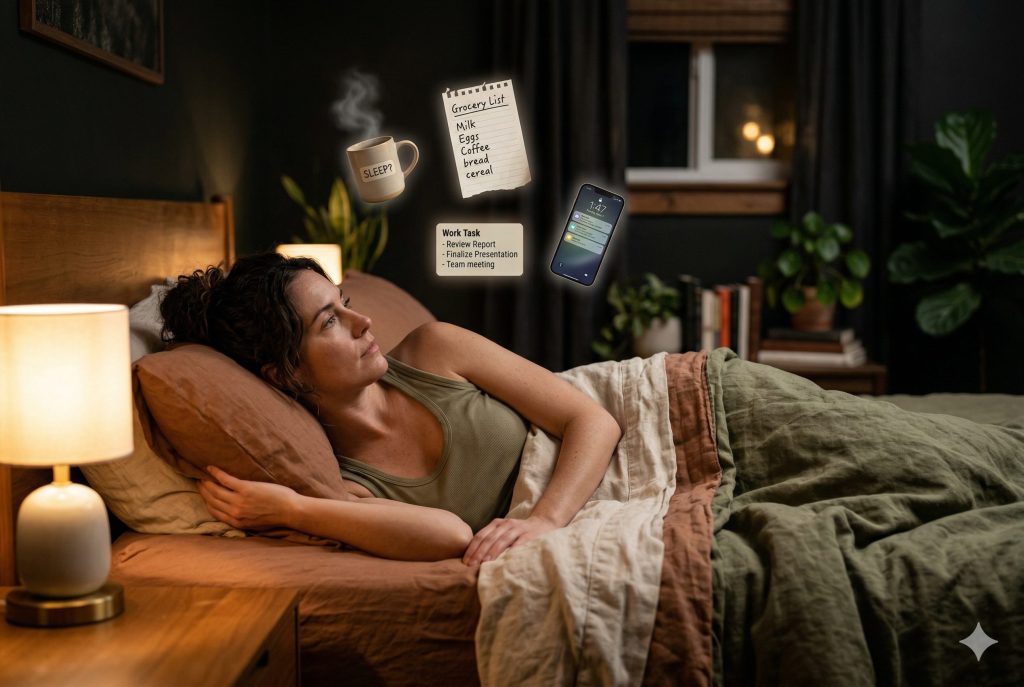
You lie down. You close your eyes. And immediately, your brain presents you with an unsolicited recap of everything you didn’t finish, everything you need to do tomorrow, and several things you probably said in 2017 that didn’t land well.
This isn’t anxiety. This is your brain’s default mode network doing exactly what it’s designed to do: surface unresolved cognitive loops the moment you stop actively distracting it. The problem is timing. At 11pm, this process has no outlet — so it runs in circles, keeping you awake.
The solution is to give your brain a structured outlet for these thoughts before you lie down, so it can let go of them when it’s time to sleep. This is called cognitive offloading, and it’s one of the most evidence-supported sleep productivity techniques available.
Research: A 2018 study in the Journal of Experimental Psychology found that writing or speaking a to-do list for the following day before bed reduced the time it took to fall asleep by an average of 9 minutes — a 45% improvement in sleep-onset latency, one of the key markers of sleep productivity.
VOZLY NIGHT PROTOCOL
Record a 5-minute “brain clear” into Vozly every night 30 minutes before bed. Cover three things: what you accomplished today (signals completion to your brain), what tomorrow’s top priority is (offloads the planning), and one thing you’re grateful for (activates a positive emotional state before sleep). This 5-minute habit consistently produces faster sleep onset and better morning energy.
Stop lying awake with a racing mind.
Vozly’s voice notes let you offload every unfinished thought before bed — so your brain finally has permission to rest.
HABIT FOUR
Evening Caffeine — The Silent Saboteur of Deep Sleep
Most people know that caffeine before bed is a bad idea. What most people don’t know is exactly when “before bed” starts. The answer is earlier than almost anyone expects.
Caffeine has a half-life of 5 to 7 hours in the average adult body. This means that a coffee at 3pm still has 50% of its stimulant effect active at 9pm, and 25% active at midnight. If you’re a slow caffeine metabolizer — which roughly 50% of people are, due to a genetic variant in the CYP1A2 enzyme — that half-life can stretch to 9 hours.
The impact on sleep productivity is not primarily about whether you fall asleep — caffeine drinkers do fall asleep. The damage is to deep sleep architecture. Caffeine blocks adenosine receptors, and this suppresses slow-wave sleep — the deepest restorative stage — even when you feel like you’re sleeping normally. You wake up tired because you technically did sleep, but without the restoration deep sleep provides.
THE 2PM RULE
Cut all caffeine by 2pm if you sleep between 10pm and midnight. If you sleep later, cut it by 3pm. That one rule, applied consistently, will produce more measurable improvement in your morning energy than any supplement or sleep gadget.
HABIT FIVE
The Doom-Scroll Trap — How Bad News Ruins Sleep Quality
Scrolling through news and social media before bed doesn’t just cause blue light exposure — it loads your nervous system with threat-relevant information right before you’re supposed to enter a rest state. Your brain’s threat-detection system, the amygdala, doesn’t distinguish between reading about a crisis and experiencing one. It responds to perceived threats with cortisol release regardless of the source.
The result: you go to bed with an activated stress response, which directly suppresses the melatonin release needed to initiate deep sleep cycles. This is one of the most underappreciated enemies of sleep productivity, because it doesn’t feel dramatic — it just feels like “staying informed.”
The fix is environmental, not willpower-based. Remove social media apps from your phone’s home screen. Replace them with Vozly. The friction of opening an app from a folder is often enough to break the automatic scroll habit — and the Vozly shortcut gives you a positive action to replace it with.
HABIT SIX
Skipping the Wind-Down Window — The 60-Minute Sleep Mistake
Your autonomic nervous system has two modes: sympathetic (fight-or-flight, active, alert) and parasympathetic (rest-and-digest, calm, recovery-ready). Falling asleep requires a full transition from sympathetic to parasympathetic dominance. This transition takes approximately 60 minutes when deliberately supported — and can take 2 to 3 hours when ignored.
Most people go directly from work, screens, or stimulating activities to lying in bed and expecting sleep. This is like flooring the accelerator on the highway and then immediately trying to park — the momentum doesn’t stop just because you stopped pressing the pedal.
A wind-down window is a deliberate 60-minute deceleration protocol. It doesn’t need to be elaborate. The key ingredients are:
Dim the lights in your space — bright overhead lighting keeps your nervous system in alert mode
Lower ambient temperature slightly — core body cooling is a direct trigger for melatonin release
Switch from consuming information to expressing it — reading, journaling, or speaking a Vozly brain dump
Avoid emotionally activating conversations or decisions — your nervous system cannot distinguish between excitement and anxiety at this stage
Do something with your hands if your mind is active — gentle stretching, tidying, or cooking something simple
Applied consistently, a 60-minute wind-down window is one of the highest-leverage sleep productivity upgrades available — and it costs nothing.
HABIT SEVEN
No Morning Intention — How Poor Sleep Productivity Starts the Night Before
This is the one most people don’t expect on a list about sleep. But it belongs here, because it’s the keystone habit that connects your night to your morning and your morning back to the next night.
When you wake up without a clear first intention — a single anchor task that defines what a successful morning looks like — your brain immediately goes into reactive mode. You check your phone, respond to demands, consume information. This reactive state activates the same stress hormones as threat response, which means that by 9am, your cortisol has already been spent on noise rather than signal.
High-cortisol mornings lead to compensatory stimulant use (more caffeine), which leads to poor sleep that night, which leads to another reactive, foggy morning. This is the cycle. And it starts not with your alarm — but with whether you decided, the night before, what the morning was for. If you want to build that morning system from the ground up, our guide on Voice Notes for Productivity: 7 Science-Backed Habits to Think Faster and Do More shows exactly how to turn your first 10 minutes into a focused, intentional start — instead of a reactive one.
VOZLY NIGHT → MORNING BRIDGE
At the end of your evening Vozly brain dump, record one final note: “Tomorrow, the one thing that matters most is…” When you wake up, that note is the first thing you open. No social media, no email. Just one voice note telling you exactly what to do. This 30-second habit closes the sleep productivity loop between every night and the morning that follows it.
YOUR ACTION PLAN
The Complete Sleep Productivity Fix — Starting Tonight
You don’t need to fix all seven habits at once. Research on habit formation consistently shows that trying to change too much simultaneously leads to reverting to all previous patterns within three weeks. Instead, pick the two or three habits on this list that feel most familiar — the ones where you thought “that’s me” — and start there.
Tonight:Set a “Screen Stop” alarm for 90 minutes before bed. Use those 3 minutes in Vozly to clear your head.
This week:Choose a fixed wake time and protect it for 7 consecutive days — including the weekend.
2pm rule:Move your last caffeine intake to 2pm and hold it there for two weeks before evaluating its effect.
Build the wind-down:Start with just 20 minutes of deceleration before bed. Add 10 minutes each week until you reach 60.
Night-to-morning bridge:End every Vozly evening note with your one priority for the following morning.
These aren’t difficult changes. They’re small, consistent shifts in what you already do — redirected toward what your brain and body actually need to recover well and perform the next day.
Sleep Productivity Is the Habit That Makes All Other Habits Work
Every productivity system in the world — Pomodoro, time blocking, deep work, GTD — relies on one invisible foundation: that you show up to the day with your cognitive resources intact. Without good sleep, no system works. With it, almost everything works better.
The seven habits in this guide are not radical interventions. They’re micro-corrections to things you’re already doing — timed slightly differently, with slightly more intention. That’s it. And Vozly is the one tool that threads through all of them: capturing your thoughts before bed, setting your morning intention, and making the transition from a racing mind to genuine rest a 3-minute habit instead of a 2-hour struggle.