


Productive procrastination is the most socially rewarded form of self-deception there is. It doesn’t look like lying on the sofa watching television. It doesn’t look like scrolling for hours or canceling plans. It looks like staying late at the office. Launching another side project. Clearing your inbox at 11 PM. Saying yes to every opportunity because the alternative — sitting quietly with yourself and nothing to do — feels genuinely unbearable.
If you use alcohol to numb your feelings, people stage an intervention. If you use work to numb your feelings, people give you a promotion. The culture actively rewards you for the very behavior that might be quietly eroding your nervous system. This is what makes productive procrastination so difficult to recognize — not because it’s subtle, but because it’s celebrated.
This post isn’t here to tell you that ambition is dangerous or that working hard is a problem. It isn’t. But there’s a meaningful difference between working hard because you love what you’re building and working hard because stopping feels terrifying. And learning to tell those two things apart might be the most honest and useful thing you do for your productivity — and your life — this year.
What Is Productive Procrastination, Exactly?
Productive procrastination is the phenomenon of staying very busy — genuinely busy, doing real things — while systematically avoiding the one task, feeling, decision, or conversation that actually matters most.
It is not classic procrastination. The classic procrastinator watches three hours of television instead of writing the report. The productive procrastinator writes six other reports instead of the one that scares them. Both are avoiding. One just has a much more impressive CV to show for it.
Psychologists call the broader pattern avoidance coping — a term coined by researchers Richard Lazarus and Susan Folkman in their landmark stress and coping theory. The idea is that when we face something emotionally overwhelming, we have two broad options: approach it, or avoid it. Avoidance coping means redirecting our attention and energy toward things that feel manageable — and away from the thing that doesn’t.
The insidious genius of productive procrastination is that it disguises avoidance as achievement. You’re not hiding under the covers. You’re building something, producing something, accomplishing something. The busyness is real. The output is real. But so is what’s being buried underneath it.
Psychologists have a term for this too: avoidance through productivity. You’re not procrastinating on work. You’re using work to procrastinate on feeling.
The Question That Changes Everything
There is one question at the heart of productive procrastination — and it’s the one most people spend years not asking themselves, because the answer is uncomfortable:
Am I running toward something, or away from something?
Ambition and avoidance can look identical from the outside. Both involve long hours, high output, and relentless forward motion. The difference is internal — in the quality of the drive, and in what happens when you stop.
If you work hard and then rest without guilt, that’s ambition. If you work hard and feel a strange low-level panic when you have nothing to do — if rest feels like a threat rather than a reward — that’s a signal worth paying attention to.
James Gross’s Emotion Regulation Theory offers a useful framework here. According to Gross, one of the most common strategies humans use to manage difficult emotions is attentional deployment — redirecting attention away from the uncomfortable experience toward something more manageable. Work is a perfect vehicle for this. When grief or anxiety or loneliness surfaces, there’s always another task to do, another problem to solve, another goal to pursue. The emotion gets pushed down. The to-do list gets shorter. And for a while, that feels like progress.
The problem is that suppressed emotions don’t disappear. Carl Jung argued this more than a century ago — that what we refuse to face doesn’t go away but instead goes underground, finding expression in other behaviors, physical symptoms, and relational patterns. The modern research is consistent with this. A 2019 study published in the Journal of Occupational Health Psychology found that workaholism — defined not by long hours but by the inability to psychologically detach from work — was significantly associated with emotional suppression and difficulty identifying one’s own internal emotional states.
In other words, the more you use work to avoid feeling, the harder it becomes to know what you’re feeling at all.
5 Signs Your Productivity Might Be Productive Procrastination
This section is the uncomfortable one. Read it gently.
1. Rest Feels Like a Problem — Not a Reward
You finish a big project and instead of feeling relief, you feel a strange restlessness. A need to immediately identify the next thing, start the next task, find the next goal. Stillness doesn’t feel restorative. It feels vaguely threatening — like something you’re not supposed to do, or something that might let in thoughts you’ve been successfully keeping out.
This is one of the clearest signatures of productive procrastination. For people using work as emotional avoidance, rest isn’t a break from the doing. It’s an exposure to the feeling — and that’s why it’s avoided as consistently as the emotion itself.
2. Your Most Important Task Keeps Not Getting Done
Here’s the irony at the heart of productive procrastination: the person practicing it is usually very productive. They accomplish an enormous amount. But if you look closely, the one thing that keeps not getting done — the difficult conversation, the creative risk, the personal decision — is always the thing with the most emotional weight.
This is the classic pattern. Every email gets answered. Every administrative task gets cleared. Every meeting gets attended. But the thing that matters most — the one that requires vulnerability, or uncertainty, or the possibility of failure — stays on the list, untouched, week after week.
3. You Can’t Explain Why You’re Tired
Burnout from genuine overwork has a recognizable cause-and-effect: you did a lot, you need to rest. But the exhaustion that comes from productive procrastination is harder to explain. You’ve been busy — very busy — but the tiredness feels deeper than physical. It has an emotional quality. A flatness. A sense of going through motions that should feel meaningful but somehow don’t.
This is what the research describes as emotional depletion — the cost not of doing too much, but of avoiding too much. Suppression takes energy. Maintaining the busyness that keeps unwanted feelings at bay is exhausting in a way that ordinary hard work simply isn’t.
4. Your Identity Has Become Your Output
You know you might be in productive procrastination territory when the question “who are you?” is answered almost entirely in terms of what you produce. Your job title. Your projects. Your accomplishments. Your role. Not your values. Not your relationships. Not what you feel or want or fear.
When identity collapses into productivity, rest becomes existentially threatening — because if you’re not producing, who are you? The work doesn’t just fill time. It fills the question of self. And anything that interrupts it risks exposing the void it was covering.
5. You’re Achieving More but Enjoying It Less
This is perhaps the most telling sign of all. Productive procrastination often coexists with impressive external results. The career is advancing. The projects are being completed. The goals are being hit. But the felt sense of meaning and satisfaction that should accompany those achievements keeps failing to arrive.
That gap — between what you’re accomplishing and how it feels to accomplish it — is important information. It suggests that the work has become functional rather than fulfilling. A mechanism for moving through time, managing internal states, and maintaining the appearance of direction — rather than an expression of something genuinely chosen.
Why This Happens: The Neuroscience of Busyness as Avoidance
Understanding why productive procrastination works — temporarily — is what makes it so hard to stop.
When you complete a task, your brain releases dopamine. It’s a small hit of reward that feels good. Over time, the brain can become conditioned to seek task completion not because the tasks themselves are meaningful, but because the dopamine response temporarily quiets the low-grade emotional distress running underneath. The busyness doesn’t resolve anything. It suppresses. And like any suppression strategy, it requires escalating input to maintain the same effect.
Cortisol — the body’s primary stress hormone — is also involved. Chronic busyness keeps cortisol chronically elevated, producing a state of hypervigilance that can feel like productivity but is actually a nervous system under sustained duress. The result is that you feel unable to stop — not because there’s so much to do, but because stopping exposes the nervous system to whatever it’s been successfully drowning out.
This is why the answer to productive procrastination is never simply “do less.” The avoidance has a function. It’s protecting you from something that feels too difficult to face. The path forward isn’t to remove the protection before you’re ready — it’s to gently develop the capacity to be with your own experience, so that the protection becomes less necessary over time.
5 Ways to Break the Productive Procrastination Cycle
1. Name What You’re Actually Avoiding
The first and most important step in addressing productive procrastination is identifying what the busyness is covering. This sounds simple and is genuinely difficult.
The most effective way to do this is to ask yourself, when you notice the urge to immediately fill a quiet moment with a task: what would I be thinking about if I weren’t doing this?
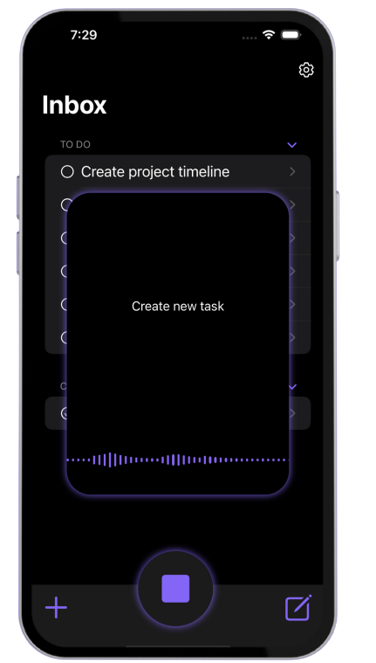
Speak the answer out loud into Vozly. Don’t type it — speak it. There’s a reason the post that inspired this piece focused on the act of giving voice to emotions: verbalizing an experience activates the prefrontal cortex and reduces amygdala activity, which means speaking what you’re avoiding literally creates neurological space to be with it. The mere act of saying “I think I’ve been working this hard because I don’t want to think about…” and finishing the sentence is a meaningful intervention.
You don’t need to solve what surfaces. You just need to see it.
2. Schedule Unstructured Time and Don’t Fill It
This is the hardest practice for people in productive procrastination patterns and also the most revealing. Once a week, block 30 minutes in your calendar with no agenda, no task, no goal. No podcast, no scroll, no self-improvement content. Just unstructured time.
Then notice what happens.
The discomfort that arises in those 30 minutes is not the enemy. It is information — about what you’ve been avoiding, what you’re hungry for, and what your actual emotional state is underneath the busyness. Most people find this practice profoundly uncomfortable at first and profoundly clarifying within a few weeks.
Use Vozly to speak a quick voice note at the end of each unstructured block. What came up? What did you notice? Not as a task — just as an honest observation. Over time, this becomes one of the most valuable self-awareness practices available.
3. Do the Thing with the Most Emotional Weight First
Productive procrastination almost always has a tell: the task that keeps not getting done despite everything else being completed. Whatever that task is — the conversation you’ve been postponing, the creative risk you haven’t taken, the decision you’ve been circling — it’s the thing your avoidance is protecting you from most.
The practice here is simple and uncomfortable: do that thing first. Before the inbox. Before the easier tasks. Before the satisfying administrative work that creates the illusion of forward motion.
Speak it into Vozly every morning as your first voice note: “The thing I’m most avoiding today is…” Completing that sentence out loud — hearing yourself say it — changes your relationship to the task. It’s no longer subconscious. It’s named. And named things have less power than unnamed things.
4. Learn to Distinguish Achievement from Relief
Not all productive procrastination is recognizable in the moment. Sometimes it only becomes visible in retrospect — when you notice that you’ve been very busy but somehow not working on what matters most.
A useful daily practice is to ask, at the end of each workday: did I do the things that genuinely matter, or did I do the things that made me feel okay? Both might have value. But only one of them is the work that actually matters.
This connects directly to the kind of proactive productivity that prevents reactive, avoidance-driven work patterns from taking over: deciding in advance what actually matters today, speaking it out loud as a commitment, and then checking at the end of the day whether you did it.
The gap between your stated priorities and your actual behavior is where productive procrastination lives. Making that gap visible — consistently, honestly — is how you begin to close it.
5. Speak Before You Bury
This is perhaps the most directly practical strategy for interrupting productive procrastination in real time.
The moment you notice the urge to immediately fill a pause with a task — to open the laptop when you were just going to have lunch, to start a new project the moment the last one finishes, to respond to emails at 11 PM instead of going to sleep — pause. Just for ten seconds.
Open Vozly and speak whatever is present. Not a task. Not a plan. Just what’s there. “I feel restless and I don’t know why.” Or: “I’m anxious about the conversation I haven’t had.” Or even: “I just want to keep working and I’m not sure I want to look at why.”
That ten-second pause — that spoken acknowledgment before burying back into productivity — is the crack in the avoidance system. It doesn’t have to fix anything. It just has to be honest. And over time, the habit of pausing to speak what’s true before returning to work builds the emotional capacity that makes productive procrastination less necessary.
Because the goal isn’t to stop being productive. It’s to let your productivity be a choice — a genuine expression of what you value and where you want to go — rather than a sophisticated way of never having to sit with yourself.
A Note on Gentleness
If any of this landed uncomfortably — if you recognized yourself in the signs or the patterns — it’s worth saying clearly: productive procrastination is not a character flaw. It’s a protective strategy. It developed for a reason. The work that kept you busy was probably also genuinely good work, and the drive behind it was probably also genuinely real.
The invitation here isn’t to dismantle your ambition. It’s to add something to it — a small, regular practice of honesty about what’s underneath. Because the research is unambiguous on this point: suppressed emotions don’t go away. They find expression through the body, through relationships, through the particular quality of exhaustion that no vacation seems to fix.
The capacity to be with your own experience — to feel what you feel without immediately reaching for a task to make it go away — is not a distraction from your best work. It is, in the end, the foundation of it.
Your voice is the fastest bridge between what you’re avoiding and what you actually need. Use it.