


Manage Your Energy—it sounds simple, but failing to do so leads to this exact moment: It is 2:00 PM on a Tuesday. You have a to-do list that is perfectly organized. You have blocked out this specific hour in your calendar for “Deep Work.” You have your coffee, your laptop is open, and the cursor is blinking. According to every time management book ever written, you have everything you need to be productive. Yet, you find yourself staring blankly at the screen, unable to string two sentences together. You check your email. You scroll through social media. You feel a wave of guilt wash over you because, technically, you have the time. Why can’t you just do the work?
The answer lies in a fundamental misunderstanding of how human beings operate. For the last century, since the dawn of the Industrial Revolution, we have been obsessed with the clock. We treat time as the ultimate currency of productivity. We optimize our schedules, we use timers, and we try to squeeze every drop of efficiency out of our twenty-four hours. But time is a finite resource. You cannot create more of it. No matter how rich or successful you are, you get the same 1,440 minutes a day as everyone else.
There is, however, a different currency that matters far more than time, yet gets a fraction of the attention: Energy. Unlike time, energy is renewable. Unlike time, energy fluctuates wildly throughout the day. And most importantly, the quantity of time you spend on a task is irrelevant if the quality of your energy is negative. If you want to achieve sustainable high performance without burning out, you must stop managing your time and start to manage your energy.
The Industrial Hangover: Why We Worship the Clock
Our current obsession with time management is a relic of a bygone era. In the early 20th century, the majority of work was manual and repetitive. If you were working on an assembly line, your output was directly proportional to the time you spent standing there. If you worked for eight hours, you produced twice as many widgets as you did in four hours. In that context, managing time made perfect sense. The goal was to keep the machine running, and the human was simply a cog in that machine.
But today, we live in the era of knowledge work. We are not paid to produce widgets; we are paid to produce ideas, solve complex problems, and make strategic decisions. In this economy, the relationship between time and output is no longer linear. You can spend ten hours staring at a problem with low energy and make zero progress. Conversely, you can spend thirty minutes on that same problem with high energy, sharp focus, and a clear mind, and solve it completely.
When we cling to the old industrial model of “hours worked,” we fall into the trap of “presenteeism.” We sit at our desks even when our brains have shut down, pretending to work because we believe that presence equals productivity. This behavior is not just inefficient; it is destructive. It leads to a state of chronic exhaustion where we are never fully working and never fully resting. We exist in a “gray zone” of mediocre performance, constantly checking the clock, waiting for permission to stop. To break this cycle and truly manage your energy, we must shift our paradigm from the external clock to our internal biology.
The Physics of Productivity: Ultradian Rhythms
To effectively manage your energy, you must first understand the biological rhythms that govern your body. Most people are familiar with the Circadian Rhythm, the 24-hour cycle that dictates our sleep and wakefulness. However, if you want to manage your energy effectively, you must understand a second rhythm: Ultradian Rhythms.
Discovered by sleep researcher Nathan Kleitman, Ultradian Rhythms are cycles of energy production and recovery that last approximately 90 to 120 minutes. During the first part of this cycle, our energy is high, our focus is sharp, and our mental capacity is at its peak. This is when we are capable of “Deep Work.” However, after about 90 minutes, our physiological resources begin to deplete. The body starts sending signals that it needs a break. These signals are subtle at first: a yawn, a momentary lapse in concentration, a desire to stretch, or a sudden hunger pang.
If we ignore these signals—which most of us do by chugging another coffee or forcing ourselves to “power through”—we push our bodies into a state of stress response. The brain begins to pump cortisol and adrenaline into the system to keep us going. We might feel a temporary spike in alertness, but this is “dirty fuel.” It is the energy of anxiety and survival, not the calm energy of creativity and flow.
By overriding our natural Ultradian Rhythms, we enter a state of diminishing returns. We might continue to sit at our desks for another two hours, but the quality of our work plummets. We make more mistakes, we become irritable, and we lose the ability to see the big picture. True productivity and the ability to manage your energy require respecting these waves.It requires working intensely for 90 minutes and then deliberately disengaging for 15 to 20 minutes to allow the battery to recharge. This is not “laziness”; it is biological necessity.
The Four Dimensions of Energy
Energy is not a single, monolithic concept. According to performance experts, human energy comes in four distinct dimensions: Physical, Emotional, Mental, and Spiritual. To truly manage your energy, you must audit and nurture all four. Neglecting one often leads to the collapse of the others.
Physical Energy: The Foundation
This is the most obvious but often the most neglected dimension. Physical energy is the raw fuel for the engine. It is determined by the quantity and quality of your sleep, your nutrition, and your movement. It is impossible to be mentally sharp if you are physically depleted. The brain is a biological organ; it consumes 20% of the body’s metabolic energy despite being only 2% of its weight. If you feed your body processed sugar and deprive it of sleep, you are essentially trying to run a Ferrari on sludge.
One of the most critical ways to manage your energy physically is glucose regulation.Large spikes and crashes in blood sugar lead to brain fog. Similarly, hydration plays a massive role; even mild dehydration can significantly impair cognitive function. But perhaps the most powerful lever for physical energy is simply movement. A brief walk outside does more to reset your energy levels than any amount of caffeine ever could.
Emotional Energy: The Quality of Fuel
If physical energy is the quantity of fuel, emotional energy is the quality. You can be physically rested, but if you are consumed by anxiety, anger, or frustration, your energy will drain rapidly. Negative emotions are “expensive” in terms of energy consumption. They activate the sympathetic nervous system (fight or flight), which burns through resources at an alarming rate.
Conversely, positive emotions like gratitude, curiosity, and confidence are renewing. They activate the parasympathetic nervous system, which aids in recovery and broadens our perspective. To manage your energy emotionally, you need to cultivate “relational recovery.” This means setting boundaries with toxic individuals who drain you and investing time with people who uplift you. It also means recognizing when you are in a “threat state” and using techniques like deep breathing or journaling to return to a baseline of safety.
Mental Energy: Focus and Cognitive Load
Mental energy is the ability to focus your attention on the task at hand. The biggest enemy of your effort to manage your energy mentally is multitasking.Every time you switch tasks—from writing a report to checking Slack, then back to the report—you incur a “switching cost.” Your brain has to unload the context of the first task and load the context of the second. This constant context switching is exhausting. It is like opening and closing a heavy door thousands of times a day.
Another massive drain on mental energy is the “Open Loop.” This concept, known as the Zeigarnik Effect, states that our brains retain unfinished tasks much more vividly than finished ones. These unfinished tasks run in the background of your mind like open apps on a smartphone, slowly draining your battery. You might not be thinking about them consciously, but your subconscious is spending energy holding onto them.
Spiritual Energy: The Force of Purpose
Spiritual energy is not necessarily religious; it is the energy derived from purpose and meaning. It is the answer to the question, “Why am I doing this?” When your work aligns with your values and you feel a sense of contribution, you tap into a deep reservoir of resilience. This is why people can work tirelessly for a cause they believe in without feeling the same fatigue they would feel at a meaningless job.
When you fail to manage your energy spiritually, work becomes drudgery. You might have the physical and mental capacity to do the job, but the will is missing. To manage your energy spiritually, you must regularly reconnect with your “Why.” You must find the “Ikigai” in your daily tasks—the intersection of what you are good at, what you love, and what the world needs.
The Cognitive Cost of Friction: Why Typing Drains You
We often overlook the mechanics of how we work when discussing energy. For knowledge workers, the primary interface with the world is the keyboard. We think through our fingers. But have you ever considered the cognitive load of typing?
Translating abstract thoughts into linear sentences, checking for spelling, worrying about grammar, and physically striking keys is a high-friction activity. It requires fine motor skills and significant pre-frontal cortex activation. When your energy is high (during a peak Ultradian cycle), this is fine. But when you are in a trough—when you are tired, distracted, or overwhelmed—the friction of typing can become a wall. You stare at the blank document, and the effort required to type the first sentence feels insurmountable. This is where procrastination begins.
This is where voice technology becomes a game-changer to help you manage your energy. Speaking is natural. It is evolutionary. We have been speaking for hundreds of thousands of years; we have been typing for less than a century. The cognitive load of speaking is significantly lower than typing.
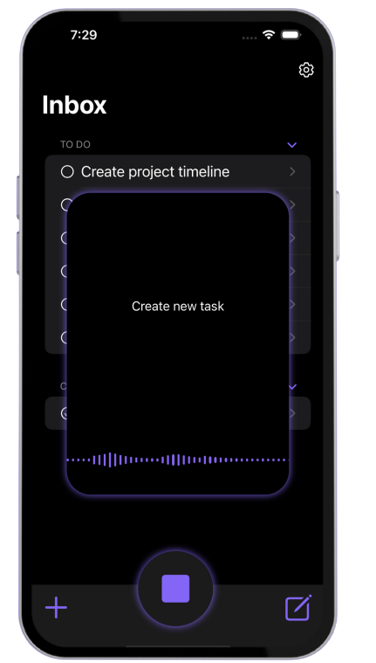
This is why tools like Vozly are not just productivity apps; they are energy management tools. When you are too tired to type, you can still speak. You can lie on a couch, close your eyes, and dictate your thoughts. By removing the friction of the interface, you bypass the resistance. You allow your ideas to flow even when your physical energy is low. You are no longer limited by your ability to sit upright and type; you are limited only by your ability to think.
The “Brain Dump” Ritual: Closing the Loops
One of the most practical ways to manage your energy is to aggressively close open loops. As mentioned earlier, unfinished tasks drain mental RAM. The problem is that these thoughts often strike us at the most inconvenient times—while driving, while cooking, or while trying to fall asleep.
If you try to “remember” these thoughts, you are paying an energy tax. If you stop what you are doing to open a laptop and type them out, you break your flow.
The solution is the Voice-First Brain Dump. Using a tool like Vozly, you can capture these open loops instantly without friction. “Vozly, remind me to email the client about the budget.” “Vozly, I just had an idea for the marketing campaign: we should use blue instead of red.” “Vozly, I’m feeling anxious about the presentation tomorrow because I haven’t prepared the slides.”
By externalizing these thoughts instantly, you stop your brain from spinning on them. You transfer the burden of memory from your biological brain to a digital second brain. The relief is palpable. It is like closing fifty tabs in your browser at once. Your processing speed increases, and your mental energy returns.
Designing Your Day for Energy, Not Time
So, how do we put all this science into practice? How do we stop scheduling time and start to manage your energy? It requires a complete redesign of the workday.
First, identify your “Chronotype.” Are you a lark (morning person) or an owl (evening person)? If you are a morning person, your peak energy is likely between 8:00 AM and 11:00 AM. This is your “Golden Time.” You must protect this time with your life. Do not spend it in meetings. Do not spend it answering emails. Use this high-value energy for your most difficult, creative, and demanding work.
Save low-energy tasks for your troughs. The “after-lunch dip” (usually around 2:00 PM or 3:00 PM) is a biological reality for most people. It is futile to try to write a complex strategy document during this time. Instead, schedule low-cognitive-load tasks: answering routine emails, administrative paperwork, or organizing files. Or, better yet, use this time for a “Voice Walk.”
A Voice Walk is a powerful technique where you leave your desk, go for a walk outside, and use Vozly to “write” or brainstorm. The movement boosts your physical energy, the change of scenery refreshes your emotional energy, and the voice interface lowers the barrier to mental output. You might find that you are more “productive” walking around the block mumbling into your phone than you were staring at your screen for two hours.
Recovery is Not a Reward; It is a Requirement
The most dangerous myth in our culture is that rest is a reward for finishing work. We tell ourselves, “I will rest when I am done.” But in the modern world, the work is never done. There is always another email, another slack message, another project. If you wait until you are “done” to rest, you will never rest.
You must view recovery as an integral part of how you manage your energy. Just as a Formula 1 car cannot finish the race without pit stops, you cannot sustain high performance without renewal.
This means taking “micro-breaks” every 90 minutes. But be careful: scrolling through Instagram is not a break. That is just flooding your exhausted brain with more data. A true break requires “disengagement.” Stare out a window. Close your eyes. Do some breathing exercises. Drink water.
It also means prioritizing sleep. Sleep is not just “downtime.” It is when your brain cleans itself. Specifically, the glymphatic system opens up during sleep and flushes out neurotoxins that build up during the day. If you cut your sleep short to “get more done,” you are essentially deciding to work with a toxic brain the next day. You are trading high-energy intelligence for low-energy stupor.
Conclusion: The Energy Audit
The shift from time management to energy management is not easy. It requires unlearning years of conditioning. It requires saying “no” to meetings that drain you. It requires the courage to step away from your desk when you hit a wall, rather than banging your head against it.
Start with a simple “Energy Audit.” For one week, do not just track what you did; track how you felt. Note when you felt in the “zone” and when you felt like a zombie. Identify the people, tasks, and environments that fill your tank and those that drain it.
Use technology to support your biology, not to enslave it. Use tools like Vozly to capture your thoughts when typing feels too heavy. Use it to vent your frustrations and clear your emotional cache. Use it to draft ideas while walking in the sunlight.
Remember, time is a container, but energy is the substance that fills it. You can have all the time in the world, but without energy, you have nothing. Stop counting the hours. Start making the hours count. Manage your energy, and the time will manage itself.

Why is it better to manage your energy than your time?
Time is finite, but energy is renewable. When you focus on how to manage your energy, you can accomplish more in less time by working during your peak biological hours.
What are the 4 types of energy to manage?
To fully manage your energy, you must balance physical, emotional, mental, and spiritual dimensions. Neglecting one often drains the others.
How can I manage my energy when I’m tired?
Use voice-first tools like Vozly to reduce friction. Speaking requires less cognitive load than typing, helping you manage your energy even when you feel exhausted.