
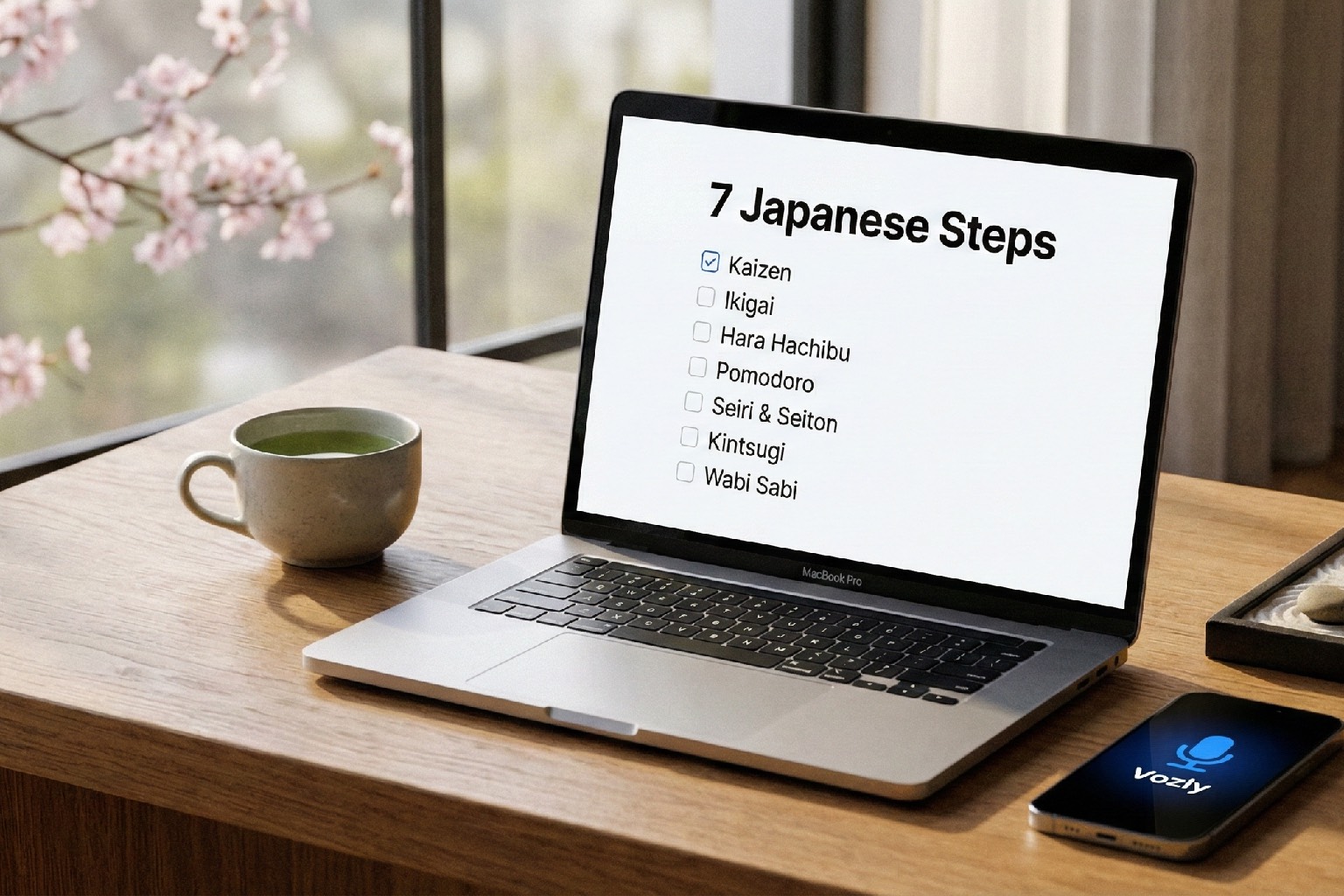

The Japanese Cure for Laziness is not just a productivity hack; it is a holistic approach to healing the spirit. In Western culture, we often view laziness as a personality flaw or a lack of willpower. However, in Japan, it is often treated as a condition—a misalignment of purpose and habit—that can be “cured” with the right mental framework. If you feel stuck, overwhelmed, or unable to start, these 7 ancient techniques will help you rebuild your focus from the ground up.
Laziness is often a symptom of “analysis paralysis.” We want to do everything perfectly, so we end up doing nothing at all. The Japanese approach cuts through this paralysis with laser precision. Here is how you can apply the Japanese Cure for Laziness using these 7 proven steps.
1. Kaizen (The 1-Minute Rule): The Antidote to Fear
Most of us procrastinate because the task in front of us feels like a mountain. “Write a book,” “Code the entire backend,” or “Clean the whole house.” When the brain sees a mountain, the amygdala (the fear center) activates, triggering a fight-or-flight response. We choose flight—usually to Netflix or Instagram.
Kaizen (Continuous Improvement) proposes a radical shift and is often the first step in the Japanese Cure for Laziness: The 1-Minute Rule.
Instead of promising to work for an hour, promise to do the task for just one minute.
- Don’t write the report; just open the document.
- Don’t clean the room; just pick up one sock.
- Don’t plan the whole project; just record one idea.
This bypasses the amygdala’s fear response. Once you start, the friction disappears. As Newton’s First Law states: An object in motion stays in motion.
🧠 How to Apply with Vozly
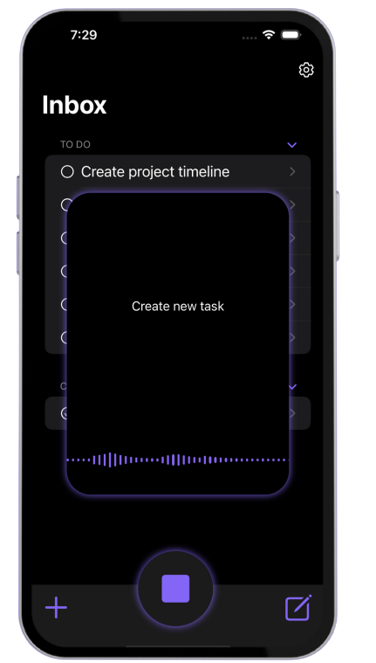
The hardest part of any task is the interface friction—opening a laptop, finding the app, typing. Use Vozly as your Kaizen trigger.
- The Command: “Vozly, I will just talk about this project for 60 seconds.”
- The Result: You start speaking. Before you know it, 5 minutes have passed, and you have outlined the entire project. You tricked your brain into productivity.
📚 Book Recommendation: One Small Step Can Change Your Life: The Kaizen Way by Robert Maurer. 🔗 Deep Dive: Read our guide on Kaizen: The Japanese Method for Continuous Improvement to master this habit.
2. Ikigai: Finding Your “Reason to Wake Up”
Laziness is often just a lack of purpose. If you don’t know why you are doing something, your body won’t give you the energy to do it. This is where Ikigai comes in.
In the West, we are taught to follow our “passion,” which is vague. Ikigai is more practical. It is the intersection of four circles:
- What you love.
- What you are good at.
- What the world needs.
- What you can be paid for.
When you feel lazy, it’s usually because you lack Ikigai, which is why finding it is a crucial part of the Japanese Cure for Laziness.
🧠 How to Apply with Vozly
Ikigai isn’t found by thinking; it’s found by noticing. Throughout your day, use Vozly to capture “Energy Spikes.”
- “I felt really energetic when I helped that client solve the bug.”
- “I felt drained when I had to fill out that excel sheet.” At the end of the month, review your Vozly logs. You will see a pattern. That pattern is your Ikigai map.
📚 Book Recommendation: Ikigai: The Japanese Secret to a Long and Happy Life by Héctor García and Francesc Miralles. 🔗 Further Reading: Harvard Business Review: How to Find Your Purpose (Link to a relevant HBR article on purpose).
3. Hara Hachibu: Stop at 80% (Energy Management)
We often think the cure for laziness is “maximum effort.” We push ourselves to 110%, crash, burn out, and then spend three days doing nothing. This “boom and bust” cycle masquerades as laziness, but it is actually exhaustion.
Hara Hachibu is a Confucian teaching instructed in Okinawa: “Eat until you are 80% full.” When applied to work, it means: Stop working before you are completely exhausted.
If you drain your battery to 0% every day, you start the next day with a deficit. If you stop at 80%, you leave a reserve of energy for tomorrow—a key principle of the Japanese Cure for Laziness. This consistency beats intensity. Hemingway famously stopped writing mid-sentence when he knew what came next, just so he could start easily the next day.
🧠 How to Apply with Vozly
Use Vozly to “park” your ideas before you quit. When you hit that 80% mark and decide to stop, your brain might panic: “But I’ll forget where I was!” Speak your current state into Vozly:
- “I’m stopping here. The next step is to fix the API endpoint, and I suspect the error is in line 45.” Now you can disconnect guilt-free, knowing your “save point” is recorded.
📚 Book Recommendation: The Blue Zones Solution by Dan Buettner.
4. Encoded Focus: The Ritualized Pomodoro
In Japan, rituals (Kata) are everything. A tea ceremony is not just making tea; it is a coded sequence of movements that induce a meditative state. Laziness attacks when focus is abstract. “I need to focus” is a wish. “I will do 4 cycles of 25 minutes” is a command.
While the Pomodoro Technique is Italian, the Japanese application emphasizes the ritual of entering focus. It’s not just about the timer; it’s about the respect you show to the block of time.Embedding rituals into your workflow is what makes the Japanese Cure for Laziness so effective.
🧠 How to Apply with Vozly
The biggest enemy of a focus block is the “Interrupting Thought.” You are 10 minutes into deep work, and suddenly: “Did I pay the electricity bill?” If you stop to check, the focus is dead. If you try to remember it, your cognitive load increases.The Solution: Keep Vozly open. When a distraction pops up, whisper it instantly: “Remind me to pay the bill.” Do not engage with the thought. Capture it and return to the ritual immediately.
📚 Book Recommendation: Deep Work by Cal Newport (While not Japanese, it perfectly aligns with the ritual of depth).
5. Seiri & Seiton: Clear Space, Clear Mind
You cannot have a clear mind in a chaotic environment. The concepts of Seiri (Sort) and Seiton (Set in Order) teach us that our physical and digital environment reflects our mental state. If your desktop is messy, your brain has to process all that visual noise, leaving less energy for actual work. This leads to decision fatigue, which feels exactly like laziness.
To fully activate the Japanese Cure for Laziness, use Vozly to declutter your mind (Mental Seiri). A chef sharpens their knife; a knowledge worker must sharpen their workflow.
🧠 How to Apply with Vozly
Use Vozly to declutter your mind (Mental Seiri). Before you start work, do a “Brain Sweep.” Talk for 3 minutes about everything bothering you—emails, chores, anxieties.
- “I’m worried about the deadline, I need to call the vet, the kitchen is messy…” Once it’s out of your head and into text, your brain realizes it doesn’t need to hold onto it. You are now light enough to move.
📚 Book Recommendation: The Life-Changing Magic of Tidying Up by Marie Kondo. 🔗 Deep Dive:Learn how to organize your digital life in our article: Digital 5S Methodology: 5 Steps to Declutter Your Mind.
6. Kintsugi: The Golden Repair of Failure
Perfectionism is the mother of procrastination. We don’t start because we are afraid it won’t be perfect. Kintsugi is the art of repairing broken pottery with gold lacquer. Instead of hiding the cracks, they highlight them. The broken bowl becomes more beautiful because it was broken.
How does the Japanese Cure for Laziness work here? Simple. Often, we stop working on a project because we made a mistake or missed a deadline. We feel “it’s ruined,” so we give up. Kintsugi Mindset says: “The mistake is part of the story.” You missed a week of gym? Good. That gap is where the gold goes. Start again today.
🧠 How to Apply with Vozly
Voice notes are inherently imperfect. You stutter, you pause, you correct yourself. Unlike a typed document which demands perfection, Vozly embraces the raw flow of thought. Use it to draft your “ugly first drafts.” Don’t try to type a perfect email. Speak a messy, broken version into Vozly first. Seeing the text—even if imperfect—gives you something to repair (edit) rather than a blank page.
📚 Book Recommendation: Wabi Sabi: Japanese Wisdom for a Perfectly Imperfect Life by Beth Kempton.
7. Wabi Sabi: Action Over Perfection
Closely related to Kintsugi, Wabi Sabi is the acceptance of transience and imperfection. Nothing lasts, nothing is finished, and nothing is perfect. Laziness often comes from waiting for the “perfect time” or the “perfect mood.”
- “I’ll start when I have a better desk.”
- “I’ll write when I feel inspired.”
Wabi Sabi teaches us that the perfect moment does not exist. There is only this moment. Imperfect action is infinitely better than perfect inaction.
🧠 How to Apply with Vozly
Just Start Talking. This is the ultimate hack. When you don’t want to work, tell Vozly why you don’t want to work.
- “I really don’t want to write this report because I’m bored and I don’t know where to start…” Often, just verbalizing the resistance breaks the resistance. By the time you finish complaining, you’ll likely find yourself saying: “Actually, maybe I can just start with the intro.”
Conclusion: Movement is Medicine
The Japanese Cure for Laziness isn’t a magic pill. It’s a shift in perspective. It turns “work” from a scary mountain into a series of small, imperfect, meaningful steps.
You have the tools. You have the ancient wisdom of Kaizen and Ikigai. And with Vozly, you have the modern technology to capture your thoughts before they fade.
The only thing left is to move. Not tomorrow. Not in an hour. Now.
🎵 Let’s Move: Your Action Soundtrack
We wouldn’t leave you without a rhythm to start your first “1-Minute Kaizen” step. You need a beat that reminds you of your own power.
🎧 Recommended Track: Sia – “Unstoppable”
Why this track? Because laziness is often just a lack of confidence. This song is the ultimate anthem of self-belief. Put your headphones on, turn the volume up, and crush that first task. You are unstoppable.

FAQ: Mastering the Japanese Cure for Laziness
What is the Japanese Cure for Laziness?
The Japanese Cure for Laziness is a collection of mental frameworks (like Kaizen, Ikigai, and Wabi Sabi) designed to overcome procrastination, boost focus, and find purpose in daily work.
Which technique is best for starting?
Kaizen (the 1-minute rule) is usually the most effective starting point for the Japanese Cure for Laziness because it bypasses the brain’s fear response by making tasks incredibly small.
Can technology help with these ancient methods?
Yes. Using voice-first tools like Vozly modernizes the Japanese Cure for Laziness by allowing you to declutter your mind instantly, which aligns with the principles of Seiri and Seiton.
How long does it take to see results?
The Japanese Cure for Laziness is not a quick fix but a lifestyle shift. However, applying the 1-minute rule usually yields immediate results in overcoming inertia.