

Identity Shift. It starts quietly. You wake up one morning, look at the goals that used to fire you up, and feel… nothing. The hobbies you loved feel tedious. The plans you made five years ago no longer resonate. You might panic and label this feeling as burnout, or perhaps even depression. But if you look closer, the symptoms don’t quite match. You aren’t necessarily sad; you are detached. You aren’t tired; you are uninspired.
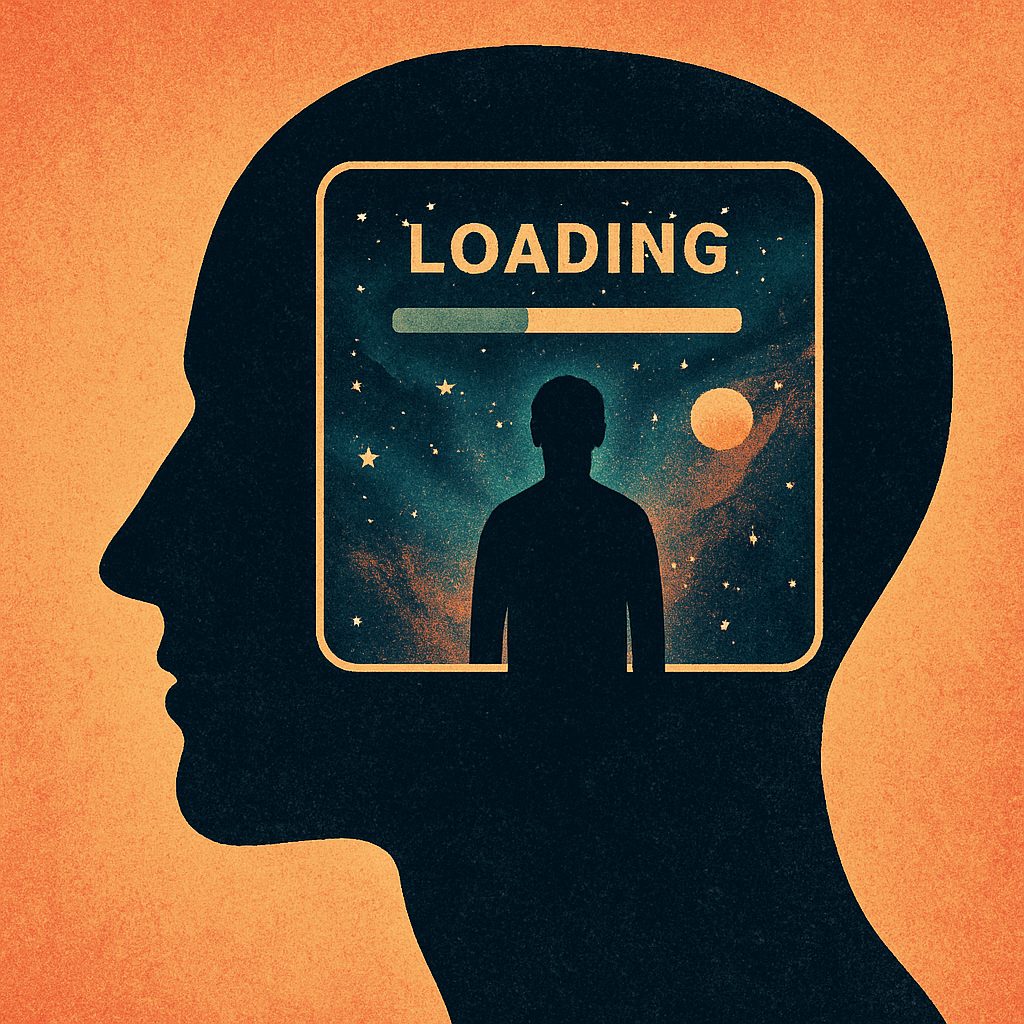
What you are experiencing is not a mental collapse. It is a profound neurological event known as an Identity Shift. Your brain is currently in the volatile gap between the “Old You” that has died and the “New You” that is struggling to be born. It is an internal software update, and right now, you are staring at the loading screen.
In this comprehensive guide, we will dismantle the neuroscience behind this phenomenon, explain why your brain’s reward systems are crashing, and provide you with the ID Calibration Protocol—a specific 3-minute technique to finalize your update and restart your life.
The Neuroscience of the Void: Why Nothing Excites You Anymore
When an Identity Shift occurs, it feels like a system failure. However, neuroscience suggests this is actually a protective and adaptive mechanism. Your brain is realizing that your old map of reality no longer leads to survival or satisfaction.
During this transition, three specific neurological mechanisms “crash” simultaneously. Understanding these will help you stop fighting the process and start managing it.
1. Your Domain Maps Are Outdated (The Dopamine Drought)
Your brain operates on “reward prediction errors.” It creates maps of the world: If I do X, I will get Y reward. For years, your career, your relationships, or your hobbies provided reliable dopamine hits because your brain valued those outcomes.
In an Identity Shift, your values change fundamentally. Suddenly, the “Old Domain Maps” stop working. You achieve a goal, but the dopamine doesn’t release. Your brain no longer “believes” in the old targets. It’s not that you are incapable of feeling joy; it’s that your neurochemistry is withholding reward signals for behaviors that no longer serve your evolution. You are pressing the button, but the machine is unplugged.
Note: This is often confused with anhedonia (a symptom of depression), but the difference is that in an identity shift, you still have the capacity for joy—you just haven’t found the new stimuli yet.
2. The Prefrontal Cortex Wipes the Slate
The Prefrontal Cortex (PFC) is the CEO of your brain. It is responsible for executive functions: planning, decision-making, and visualizing the future. When your identity is stable, the PFC projects your current self into the future to create plans.
However, when the “Old Self” dissolves, the PFC loses its reference point. It cannot plan for a “New Self” that doesn’t exist yet. Consequently, it wipes the old plans but has no data to construct new ones. When you try to think about the future, you don’t see a path; you see a blank void. This isn’t a lack of imagination; it is a temporary suspension of executive projection while the system reboots.” Bununla değiştir: “This isn’t a lack of imagination; it is a characteristic symptom of an Identity Shift where executive projection is suspended while the system reboots.
3. The Default Mode Network (DMN) Goes Into Overdrive
Have you felt like your mind is constantly echoing, asking “Who am I?” or “What is the point?” This is the work of the Default Mode Network (DMN). The DMN is a network of interacting brain regions active when you are not focused on the outside world—when you are daydreaming, reflecting, or ruminating.
During an Identity Shift, the DMN becomes hyperactive. It is frantically searching for a new self-concept to latch onto. This creates a noisy internal environment where you feel disconnected from reality (dissociation) and stuck in your own head.If you need a practical way to quiet this noise, check out our guide on using the Overthinking Box technique.” You perceive this high-volume internal chatter as “numbness” to the outside world, but it is actually intense internal processing.
This Is Not a Crash; It’s a Construction Site
Society tells us that consistency is key. We are taught that if we aren’t moving forward, we are failing. But nature works in cycles of death and rebirth. A caterpillar does not simply grow wings; it dissolves completely into a genetic soup before reassembling as a butterfly.
You are in the soup.
Recognizing an Identity Shift reframes your suffering. You aren’t broken. You are under construction. The anxiety you feel is the energy of potential energy waiting to be directed. The boredom is space being cleared for new passions.
The Solution: The ID Calibration Protocol
Waiting for an Identity Shift to resolve itself passively can take years. To accelerate this process and help the “New You” take the wheel, we use a technique called ID Calibration.
This is a 3-minute cognitive restructuring protocol designed to manually override the brain’s “loading screen” and signal the Prefrontal Cortex to start building a new future.
Step 1: The “Finished” List (Closing the Old Software)
Your brain needs closure. It needs to know that the old goals are not “failed,” but “finished.”
- Action: Take a piece of paper and write down the “Finished List.”
- What to write: List 5 attributes, habits, or roles of your Old Self that you are formally retiring.
- Example: “I am finished with being the person who says ‘yes’ to everyone.”
- Example: “I am finished with seeking validation from my corporate title.”
- Example: “I am finished with these specific outdated friends.”
- Why it works: This sends a clear signal to your brain to stop allocating energy to these old neural pathways. It reduces the synaptic noise.
Step 2: The “Initiation” List (Programming the New)
Now, we must give the Prefrontal Cortex a new target to aim at.
- Action: Write down the “Initiation List.”
- What to write: List 5 attributes or realities of the version of you that is trying to be born.
- Example: “I am starting to become a person who prioritizes deep work.”
- Example: “I am initiating a life centered around creative freedom.”
- Example: “I am becoming physically vital and energetic.”
- Why it works: You don’t have to be these things yet. By defining them, you give your Reticular Activating System (RAS) a new filter. Your brain will start scanning the environment for evidence and opportunities that match this new list.
Step 3: The Micro-Action (The System Reboot)
Thinking changes nothing; action changes everything. The brain needs proof that the new system is online.
- Action: Select ONE tiny micro-action from your “Initiation List” and do it immediately.
- The Rule: It must be small enough that you cannot fail.
- If you want to be a writer: Write one sentence.
- If you want to be fit: Do five pushups.
- If you want to be social: Send one text.
- Why it works: This creates a fresh dopamine feedback loop. Your brain sees the action, releases a small amount of reward chemicals, and tags the “New Identity” as valid. It says, “Okay, the new system is active. Let’s run this program.”
Embracing the Upgrade
If you are reading this and feeling lost, take heart. The feeling of meaninglessness is not the end of your story; it is the prologue to your best chapter. An Identity Shift is a luxury. It means you have outgrown your container.
Don’t medicate the numbness with distraction. Don’t force yourself to care about things that no longer matter; accept that an Identity Shift requires letting go. Use the ID Calibration Protocol. Close the old tabs in your browser, define the new destination, and take that first micro-step.
Your upgrade is ready to install. Are you ready to click “Accept”?
[Link: Research on Neuroplasticity and Adult Development – Harvard Health]