

Think in English from day one, and you will save yourself years of struggle. Many learners believe that they need to reach an advanced level before they can stop translating in their heads. But the truth is, waiting to be “ready” is exactly what keeps you stuck in the translation trap. If you want to speak fluently without pausing to find the right words, you must train your brain to process the language directly.
The good news? You don’t need to live abroad to achieve this. You just need to change your internal monologue. In this guide, we will show you how to switch your daily routine to English using a simple tool you already need: your to-do list.
Why Is It So Hard to Think in English?
The main reason most students cannot think in English is that they treat the language as a subject to be studied, rather than a tool to be used. When you see a table, your brain likely says “Masa,” and then you force it to translate “Masa” to “Table.” This extra step creates a lag in your speech.
This is called the “Translation Trap.” It forces your brain to work twice as hard. To break this cycle, you need to associate the object or action directly with the English word. The most effective way to do this is by narrating your life as it happens.
The “Internal Monologue” Technique to Think in English
You have a voice in your head that is constantly planning, commenting, and observing. Currently, that voice speaks your native language. To think in English, you simply need to give that voice a new script.
We can break this down into three easy levels. You don’t have to rush; start where you feel comfortable.
Level 1: Naming Objects (The Noun Phase)
Look around you right now. What do you see? Instead of ignoring your surroundings, acknowledge them in English.
- “Computer.”
- “Coffee.”
- “Window.” Don’t construct sentences yet. Just label your world.
Level 2: Narrating Actions (The Verb Phase)
As you move through your day, narrate what you are doing.
- “I am walking.”
- “I am opening the door.”
- “I am drinking water.” This connects the physical action to the English verb, bypassing translation.
Level 3: Planning Your Day (The Sentence Phase)
This is where true fluency begins. Instead of just observing, start planning.
- “I need to finish this report by 2 PM.”
- “I should call my mom.”
This is the perfect moment to introduce a tool that anchors this habit: Vozly.
How Vozly Helps You Think in English Automatically
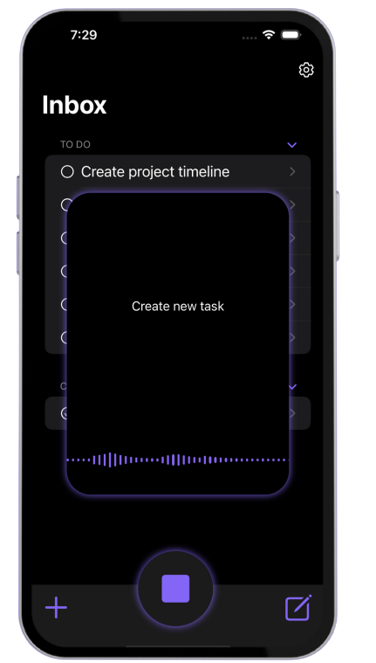
Willpower is often not enough to build a new habit. You need a trigger. Vozly, as a voice-powered to-do list app, acts as that trigger.
When you have a task to remember, your old habit was to write it down in your native language. Now, challenge yourself to speak it into Vozly in English.
- Instead of writing “Süt al,” open Vozly and say: “Buy milk.”
- Instead of writing “Toplantı 5’te,” say: “Meeting at 5 PM.”
By using your voice, you activate the “production effect,” which we discussed in our previous article [Make Learning English Easy with Voice Notes]. Hearing yourself speak these plans reinforces the neural pathways required to think in English.
Because Vozly relies on voice input, you don’t have time to overthink or worry about perfect spelling. You just speak. This urgency mimics real conversation and forces your brain to access English vocabulary instantly.
The Science Behind the Strategy: Reducing “Cognitive Load”
You might wonder, “Does talking to an app really change my brain?” The answer lies in a concept psychologists call [Cognitive Load].
When you speak your native language, the process is automatic. But when you translate in your head (Native -> English), you are forcing your brain to perform a complex, two-step operation. This consumes a huge amount of mental energy, leading to hesitation and fatigue.
By using Vozly to capture tasks directly in English, you are practicing “Direct Association.”
- Old Way: See concept → Find native word → Translate to English → Speak.
- Vozly Way: See concept → Speak English.
Eliminating that middle step reduces cognitive load. Research suggests that minimizing this mental burden is key to achieving fluency. You aren’t just memorizing words; you are rewiring the neural pathways to bypass your native language entirely.
Conclusion: Start Small, but Start Today
Learning to think in English is not a magic switch you flip; it is a muscle you build. It starts with a single word, then a phrase, and finally, a complete thought.
Don’t let the fear of making mistakes stop you. Your to-do list is a private space. No one is judging your grammar when you remind yourself to buy groceries. Use this freedom to experiment.
Download Vozly today, and make a promise to yourself: for the next 24 hours, your plans, your reminders, and your inner thoughts will be in English. It’s time to stop translating and start living the language.