


The modern workplace is a chaotic environment designed to keep you in a constant state of high alert. Picture your typical Tuesday morning: You sit down at your desk, determined to finally focus on that major strategic project. But before you can even open the document, your Slack pings with a “quick question” from a colleague. An email marked with a red exclamation point lands in your inbox.
Your phone buzzes with a calendar reminder for a meeting you forgot about. Suddenly, your carefully planned morning is hijacked. You spend the next three hours reacting to everyone else’s emergencies, and your strategic project remains untouched. You feel exhausted, yet you have accomplished nothing of real value.
This is not a failure of your willpower; it is a fundamental flaw in how we are conditioned to respond to modern communication. We are drowning in a sea of “ASAP” culture, where everything feels like a blazing fire that needs your immediate attention. But what if the vast majority of these fires are completely fake? What if the secret to true productivity is not working faster, but radically changing how you filter your tasks?
Welcome to the ultimate guide on escaping the “Fake Urgency Trap.” In this comprehensive masterclass, we are going to explore the psychological mechanisms that force us to react to meaningless pings, how the legendary Eisenhower Matrix can rescue your focus, and why modern voice-first AI tools like Vozly are the missing link to making this classic system work in the 21st century.
The Psychology of the Fake Urgency Trap
To solve the problem, we must first diagnose the disease. Why do we abandon our most important, life-changing goals just to answer a trivial email within thirty seconds? The answer lies deep within our evolutionary biology.
Our brains are wired with an ancient survival mechanism called the amygdala. Thousands of years ago, if a bush rustled nearby, your amygdala triggered an immediate “fight or flight” response. That sudden stimulus meant a predator might be attacking, and reacting instantly was a matter of life and death. Fast forward to today: there are no saber-toothed tigers in your office, but your brain processes the sudden “ding” of a notification with the exact same biological panic.
This is the core of the Fake Urgency Trap. Technology platforms are deliberately engineered to hijack this primitive part of your brain. They use bright red notification badges, disruptive sounds, and unread counts to manufacture artificial stress. When you respond to a meaningless Slack message immediately, you get a tiny hit of dopamine—the “achievement” chemical. Your brain feels a false sense of accomplishment. You feel productive because you are busy, but being busy is not the same as being effective.
You become addicted to putting out small, fake fires, while your actual career-defining goals—the ones that require deep, uninterrupted focus—burn to the ground. You need a robust, foolproof filter to separate the noise from the signal. This is exactly where the Eisenhower Matrix comes into play.
What is the Eisenhower Matrix?
Before we explore how to supercharge this system with modern AI, we need to understand its brilliant foundation. The Eisenhower Matrix (also known as the Urgent-Important Matrix) is a time management and prioritization framework attributed to Dwight D. Eisenhower, the 34th President of the United States and a five-star general during World War II. Eisenhower was famous for his incredible ability to sustain high productivity over decades, and his secret was a simple but profound realization: “What is important is seldom urgent, and what is urgent is seldom important.”
The Eisenhower Matrix forces you to evaluate every single task on your to-do list through two critical lenses: Urgency and Importance.
- Urgent tasks require immediate action. They are the visible problems, the ringing phones, and the deadlines that are right in your face. They are usually associated with achieving someone else’s goals.
- Important tasks contribute to your long-term mission, values, and massive growth. They require strategic thinking, planning, and proactive effort. They rarely have an immediate deadline.
By evaluating tasks against these two criteria, the Eisenhower Matrix divides your workload into four distinct quadrants:
Quadrant 1: Do First (Urgent and Important)
These are the genuine crises. A server crashing, a critical client threatening to leave, or a hard deadline for a major project today. You cannot ignore these. You must do them immediately. However, if you spend all your time in this quadrant, you will suffer from extreme burnout.
Quadrant 2: Schedule (Important, Not Urgent)
This is the magic quadrant. This is where true leadership, deep work, and exponential growth happen. Strategic planning, learning new skills, relationship building, and proactive maintenance live here. Because these tasks never scream for your attention, they are the first to be neglected when fake urgency strikes. Your goal should be to spend the majority of your time in this quadrant of the Eisenhower Matrix.
Quadrant 3: Delegate (Urgent, Not Important)
Welcome to the Fake Urgency Trap. These are the interruptions, the pointless meetings, the “reply all” email chains, and the favors people ask of you. They feel pressing right now, but they do absolutely nothing to advance your goals. The classic Eisenhower Matrix rule here is to delegate these tasks, automate them, or simply push back and say no.
Quadrant 4: Delete (Not Urgent, Not Important)
These are pure time-wasters. Mindlessly scrolling through social media, binge-watching television when you should be sleeping, or organizing your desk drawer for the third time this week to avoid real work. These tasks offer zero value and should be ruthlessly deleted from your schedule.
The Paradox of Categorization: Why the Matrix Fails Us Today
In theory, the Eisenhower Matrix is flawless. It is a perfect logical model. So why do so many smart professionals fail to use it consistently? Why do we still find ourselves drowning in Quadrant 3?
The failure is not in the matrix itself, but in the cognitive load required to use it in the digital age. When Eisenhower invented this system, he was dealing with physical memos, scheduled briefings, and a manageable flow of information. Today, the average knowledge worker receives hundreds of distinct data points, requests, and notifications every single day.
If you have a to-do list with 50 chaotic items on it, asking your brain to sit down and logically categorize each item into the four quadrants of the Eisenhower Matrix is an agonizing task. It creates massive “Decision Fatigue.” Decision fatigue is the psychological phenomenon where the quality of your decisions deteriorates after a long session of decision-making.
Your brain is already tired from dealing with the stress of your actual work. When you force it to manually analyze 50 tasks and decide, “Is this urgent or important?”, your brain simply gives up. The friction is too high. The act of organizing your work becomes a monumental task itself. So, what do you do? You abandon the Eisenhower Matrix, revert to System 1 thinking, and just start answering the loudest, most annoying emails first. You fall right back into the Fake Urgency Trap.
The Voice-First Revolution: Solving Decision Fatigue
This is the exact bottleneck where modern technology must intervene. We don’t need a better piece of paper to draw the Eisenhower Matrix on; we need a system that removes the cognitive friction of categorizing the data. This is why voice-first AI productivity tools, specifically Vozly, are revolutionizing task management.
Think about how much easier it is to speak than to type. When you are overwhelmed, sitting at a keyboard and trying to build a structured, color-coded list is paralyzing. But talking? Talking is a natural, low-friction release valve for a stressed mind.
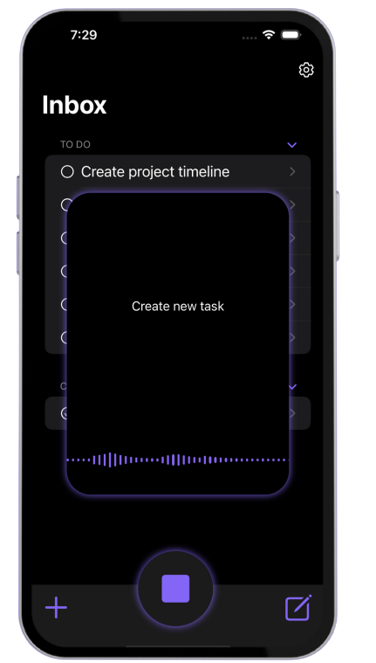
Imagine integrating Vozly with the philosophy of the Eisenhower Matrix. Instead of agonizing over a blank spreadsheet, you simply tap a button and do a verbal brain dump. “I need to finalize the Q3 budget by tomorrow, that’s critical. Oh, and John asked me to review his slide deck, but honestly, that can wait until next week. I also need to buy dog food, and I really must start outlining that new marketing strategy…”
You just speak the chaos out loud. You offload the mental burden. Then, the AI engine processes your natural speech, analyzes the context, the deadlines, and the implicit priorities, and automatically maps your chaotic thoughts directly into a perfectly structured Eisenhower Matrix. The AI handles the decision fatigue. It instantly shows you what is a real crisis (Quadrant 1) and what is just fake urgency masquerading as a priority (Quadrant 3).
The Eisenhower Matrix: 5 Secrets to Escape Fake Urgency
Now that we understand the psychology and the technological solution, how do we implement this in our daily lives? Here are the 5 brilliant secrets smart leaders use to integrate the Eisenhower Matrix with voice productivity and permanently escape the trap of fake urgency.
1. Audit Your Inputs (The “Ping” Diet)
You cannot prioritize effectively if your environment is constantly screaming at you. The first step to making the Eisenhower Matrix work is to aggressively reduce the number of inputs demanding your attention. Turn off all non-essential notifications on your phone and computer. Do you really need a pop-up alert every time someone “likes” a message in a company Slack channel? No. That is artificial urgency. By silencing the noise, you create the mental silence required to actually hear your own thoughts and recognize what truly belongs in Quadrant 2.
2. Vocalize the Chaos (The Daily Brain Dump)
Do not trust your working memory. When you keep tasks in your head, they all feel equally terrifying and urgent. Make it a daily ritual to perform a “Vocal Brain Dump.” At the end of every workday, or the very beginning of the morning, step away from your keyboard. Open Vozly and just start talking. Speak every task, anxiety, and project idea out loud. Let the AI transcribe and process the raw data. This simple act of externalizing your thoughts significantly lowers your cortisol levels and stops the anxiety loop in its tracks.
3. Separate Action from Organization
The biggest mistake people make with the Eisenhower Matrix is trying to execute tasks while they are still organizing them. This context-switching destroys your focus. Use Vozly to handle the organization asynchronously. You speak the tasks; the AI categorizes them into Do, Schedule, Delegate, and Delete. Once the AI presents you with your clean, organized Eisenhower Matrix, only then do you transition into “Action Mode.” You look at Quadrant 1, and you execute without second-guessing yourself.
4. Fiercely Protect Quadrant 2 (Deep Work)
The ultimate goal of the Eisenhower Matrix is not to become better at handling emergencies; it is to prevent emergencies from happening in the first place. The only way to do this is by spending time in Quadrant 2 (Important, Not Urgent). These are the strategic tasks that move the needle. However, because they are not urgent, you must artificially create urgency for them. When your Vozly AI identifies a Quadrant 2 task, immediately block out an unbreakable 90-minute session on your calendar for “Deep Work.” Treat this appointment with yourself with the same respect you would give to a meeting with your CEO.
5. Automate the Deletion and Delegation
The magic of combining the Eisenhower Matrix with a tool like Vozly is how easily you can handle the bottom half of the matrix. When you verbally note a task that is Urgent but Not Important (Quadrant 3), immediately use your voice to delegate it. “Vozly, draft an email to Sarah asking her to handle the weekly reporting.” For Quadrant 4 tasks, be ruthless. The most productive word in the English language is “No.” When the AI shows you a list of tasks that have zero impact on your goals, experience the sheer joy of highlighting them and pressing delete.
Real-World Scenarios: The Matrix in Action
Let us look at how this methodology transforms the chaotic lives of modern professionals.
The Overwhelmed Startup Founder: A founder is wearing twenty different hats. Marketing, product, hiring, and fundraising. Their inbox is a nightmare of fake urgency. Instead of drowning, they take a 15-minute walk every morning. They use their voice tool to dictate everything on their mind. By the time they return to their desk, their AI has populated an Eisenhower Matrix. They immediately see that redesigning the logo (Quadrant 4) is a distraction from the fact that they need to finish the investor pitch deck today (Quadrant 1). The path is clear.
The Stressed Middle Manager: A manager feels like their entire day is spent answering quick questions from their team. They have no time for their own strategic work. They start applying the Eisenhower Matrix. When a team member asks for a meeting about a minor software glitch, the manager recognizes it as Quadrant 3 (Urgent to them, Not Important to the grand strategy). Instead of dropping everything, the manager delegates the troubleshooting to IT and reclaims that hour for Quadrant 2 planning.
Conclusion: Stop Typing, Start Leading
We live in an era where attention is the most valuable currency in the world. Every app, every email, and every notification is explicitly designed to steal that currency from you by wrapping itself in a cloak of fake urgency. If you do not have a robust system to defend your attention, you will spend your entire career reacting to other people’s priorities.
The Eisenhower Matrix has survived for decades because its underlying philosophy is bulletproof. But we can no longer rely on pen and paper to manage the relentless digital onslaught. We must evolve.
By utilizing voice-first technology to bypass decision fatigue, you can effortlessly transform your chaotic thoughts into a perfectly structured Eisenhower Matrix. You can finally stop reacting, stop typing, and start leading. Let the AI organize the noise, so you can focus on doing the deep, important work that actually changes the world. Speak your mind, escape the trap, and reclaim your time today.

FAQ: Mastering the Eisenhower Matrix
What is the main goal of the Eisenhower Matrix?
The primary goal is to shift your focus away from tasks that are merely “urgent” (putting out fake fires) and allocate your best energy to tasks that are “important” (long-term strategy, deep work, and personal growth).
Why do I struggle to use the Eisenhower Matrix consistently?
Most people struggle due to “Decision Fatigue.” Manually evaluating and sorting dozens of tasks daily requires immense cognitive energy. Using voice-to-text AI tools to verbalize and automatically sort your to-do list removes this mental friction.
What is the difference between Urgent and Important?
Urgent tasks demand immediate attention and are often associated with someone else’s goals or sudden problems (like a ringing phone). Important tasks contribute directly to your own long-term mission, values, and high-level goals, but they rarely have immediate deadlines attached to them.