
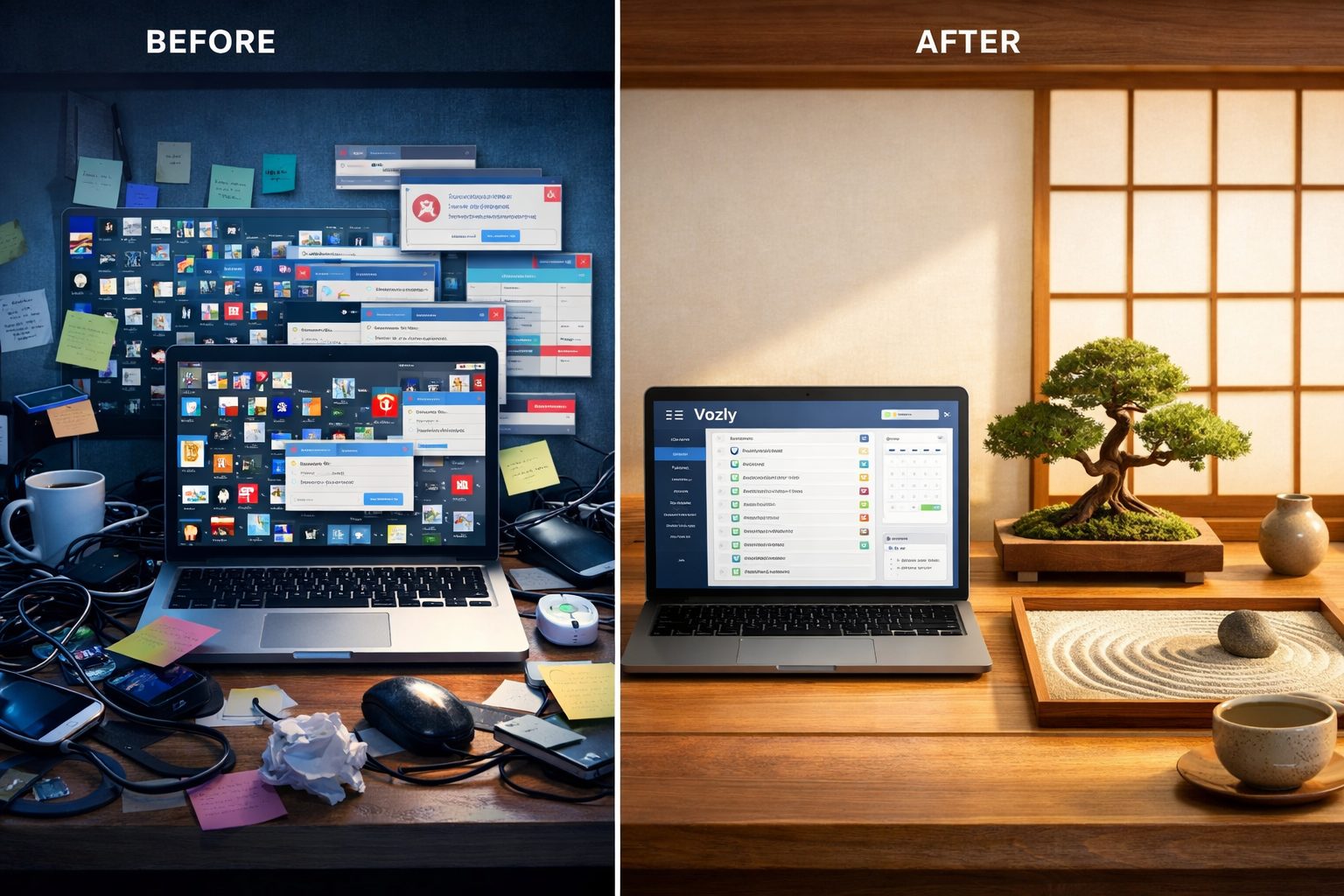

Imagine walking into a Toyota factory in Japan. The floors are spotless, every tool has a shadow outline, and efficiency hums in the air like electricity. Now, imagine walking into your own digital brain—or worse, looking at your computer desktop.
If your desktop looks like a grenade went off in a folder factory, or if your browser tabs are shrinking into microscopic panic buttons, you are suffering from “Digital Hoarding.”
We often think of clutter as physical—piles of clothes or messy desks. But in 2026, the most dangerous clutter is invisible. It’s the unread emails, the mental to-do lists keeping you awake at 3 AM, and the scattered notes app. This is where the Digital 5S Methodology comes in.
Originally designed for manufacturing efficiency, we are adapting this legendary Japanese framework to perform a factory reset on your mind. By applying the Digital 5S Methodology, you won’t just clean up your files; you will reclaim your mental bandwidth.
What is the Digital 5S Methodology?
The 5S system stands for five Japanese words: Seiri, Seiton, Seiso, Seiketsu, and Shitsuke. While it started on the assembly line, it is actually a philosophy of mind.
It is deeply rooted in the philosophy of Kaizen, which focuses on small, continuous improvements rather than sudden, drastic changes. If 5S is the cleaning, Kaizen is the mindset that keeps it clean. You can read more about how Kaizen: The Japanese Method for Continuous Improvement transforms habits in our previous deep dive.
Applying a Digital 5S Methodology means treating your attention span like a precious resource that shouldn’t be wasted on searching for a lost password or remembering to buy milk.
Let’s break down the 5 steps to declutter your mind.
Step 1: Seiri (Sort) – The Art of Deleting
Seiri is about separating the essential from the non-essential. In a digital context, this is the “Brain Dump” phase.
Your brain is a terrible hard drive. It is designed to process ideas, not store them. When you try to remember tasks, dates, and ideas, you create “cognitive load.”
- The Audit: Look at your apps, your open tabs, and your mental list. Does this serve a purpose right now?
- The Purge: Unsubscribe from newsletters you never read. Close tabs that are “for later” (you won’t read them).
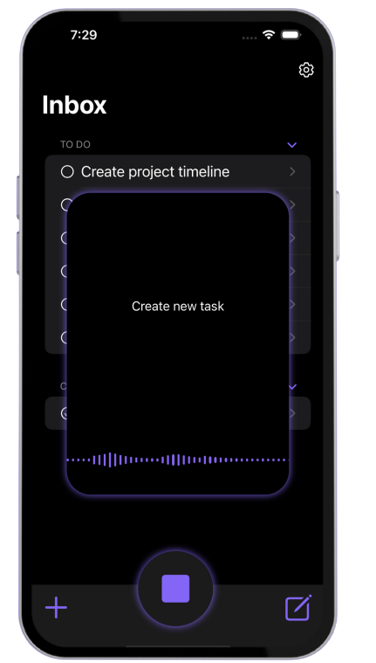
- The Brain Dump: This is crucial. Use a voice-first tool like Vozly to get every single thought out of your head. Don’t organize them yet; just capture them.
Pro Tip: If a thought takes up space in your head but pays no rent (doesn’t help you act), evict it using the Digital 5S Methodology.
Step 2: Seiton (Set in Order) – A Place for Everything
Once you’ve sorted the mess, Seiton dictates that every item must have a specific home. “A place for everything, and everything in its place.”
In the Digital 5S Methodology, this means your thoughts need a structured home, not a scattered existence across Post-it notes and WhatsApp messages to yourself.
- Categorize: In Vozly, create distinct lists: “Work,” “Home,” “Groceries,” “Someday/Maybe.”
- Prioritize: Arranging tasks not by when they arrived, but by their impact.
- Accessibility: The rule of Seiton says you should be able to find any tool (or idea) within 30 seconds. Because Vozly converts your voice to text, your thoughts are instantly searchable.
Step 3: Seiso (Shine) – The Daily Digital Scrub
Seiso means cleaning or shining. In a factory, this prevents machinery failure. In your life, it prevents “burnout failure.”
You can’t apply the Digital 5S Methodology once a year and expect it to work. It requires a daily micro-habit.
- Zero Inbox (Mental): At the end of the day, look at your Vozly list. Mark done what is done. The act of “checking off” releases dopamine.
- Clear the Cache: Close all your browser tabs before you sleep. Start tomorrow with a blank slate.
- Review: Spend 5 minutes reviewing your captured voice notes. Do they need action, or can they be archived?
Step 4: Seiketsu (Standardize) – Automate Your Order
How do you ensure the chaos doesn’t return? Seiketsu is about creating rules and standards.
To successfully implement the Digital 5S Methodology, you need personal protocols:
- The 2-Minute Rule: If a task takes less than 2 minutes, do it immediately.
- The “Capture First” Rule: Never trust your memory. Standardize the habit of pressing the record button on Vozly the moment an idea strikes.
- The Notification Protocol: Turn off all non-human notifications (apps, news, games). Only let actual people interrupt you.
Standardization removes the “decision fatigue” of wondering what to do with a new piece of information.
Step 5: Shitsuke (Sustain) – The Discipline of Consistency
This is the hardest step. Shitsuke is the discipline to keep the other 4S’s going without being told.
Most people try to get organized, fail after a week, and blame the tools. The Digital 5S Methodology fails only when discipline fades.
- Respect the System: If you start writing notes on your hand again, you break the chain.
- Continuous Improvement: Just like Kaizen, ask yourself weekly: “Is my system working? Am I feeling lighter?”
Why Voice is the Ultimate “5S” Tool
You might wonder, why use a voice app like Vozly for the Digital 5S Methodology instead of a notebook?
Speed is the essence of order. Typing is slow. Writing is even slower. The average person types 40 words per minute but speaks 150 words per minute. When you try to type a thought, the friction of unlocking your phone and finding the keyboard often makes you lose the thought—or worse, you get distracted by Instagram on the way to the Notes app.
Voice is frictionless. It captures the raw data of your mind instantly (Seiri), allows AI to organize it (Seiton), and keeps your mind clear (Seiso).
Conclusion: Clean Your Mind, Not Just Your Desk
The Digital 5S Methodology is not just about having a tidy computer; it is about having a tidy mind. In a world screaming for your attention, the ultimate rebellion is to be organized, calm, and focused.
Don’t let your brain become a junk drawer. Adopt the 5S mindset today. Speak your chaos into order with Vozly, and watch your productivity flow like a well-oiled Japanese machine.