

Establishing clear daily productivity boundaries is the single most effective strategy to escape the modern trap of “productivity guilt.” If you often finish your workday feeling like you haven’t accomplished enough—despite working for ten hours straight—you are missing this crucial psychological line in the sand.
It is 10 PM. You have been online all day, answering emails, attending Zoom calls, and managing crises. Your brain is tired, your eyes are straining, but as you try to relax or sleep, a nagging thought appears: “You didn’t do enough today. There is still so much left.”
This is the modern knowledge worker’s biggest dilemma: When does work actually end?
Unlike factory work or physical labor, knowledge work does not have a clear finish line. There is always another email to send, a project to tweak, a metric to analyze, or a skill to learn. Without artificial limits, work behaves like a gas—it expands to fill every available corner of your life. This leads to chronic stress and burnout.
The solution isn’t doing more work or finding a better calendar app. According to productivity expert Scott H. Young, the most underrated technique is defining what “finished” looks like before you even start the day. You need to establish firm daily productivity boundaries.
In this comprehensive guide,we will explore why you never feel “done,” the psychology behind closed lists, and how you can use the Vozly app to effortlessly draw that line and reclaim your peace of mind.
The Modern Trap: The Infinite To-Do List
To understand why we need daily productivity boundaries, we first have to look at how most people manage their tasks. The majority of professionals use to-do list apps incorrectly. They treat them as “wish lists” or “dumping grounds,” throwing every passing thought, assignment, and long-term goal into a massive digital pile.
The result? A list of 50+ items that is mathematically impossible to finish in a single day.
The Psychology of Unfinished Business
Psychologists call the stress resulting from this infinite list the Zeigarnik Effect. This phenomenon states that our brains remember uncompleted tasks better than completed ones. Essentially, your brain hates open loops.
When you have a list of 20 things and you only do 10, your brain does not celebrate the 10 you finished. Instead, it fixates on the 10 you didn’t. Every unchecked box on your list drains your mental energy in the background, creating a low-level hum of anxiety.
Without established daily productivity boundaries, this anxiety follows you home. It sits with you at the dinner table. It watches Netflix with you. It prevents true relaxation because, subconsciously, you are still “at work.”

The “Underrated” Solution: Defining Done
Scott H. Young creates a distinction between two types of productivity strategies: “Open Lists” and “Closed Lists.”
- Open Lists: You work on tasks as they come up or work down a long list until you run out of time (or energy). You never actually “finish”; you just stop because you are exhausted.
- Closed Lists (Boundaries): You decide strictly before you start working what constitutes a “finished day.”
The core idea is to make a contract with yourself. You ask: “What reasonable, specific set of tasks must I complete today to consider this day a success?”
This is your boundary. Once you cross that line—whether it is 5 PM or 2 PM—you must stop working. You have fulfilled your contract. You have earned the right to rest without guilt
7 Reasons You Need Daily Productivity Boundaries
Why is this technique so crucial for your long-term success and mental health? Let’s dive deep into the seven key benefits.
1. It Eliminates “Productivity Guilt”
Guilt is a terrible fuel for work. It burns dirty and destroys the engine. When you work from an open list, you always feel like you are behind. By setting daily productivity boundaries, you create a binary state: Success or Failure.
When you tick off the last item on your closed list, your brain receives a powerful “Mission Complete” signal. This allows you to switch off fully. You can enjoy your evening hobbies or time with family knowing you kept your promise to yourself.
2. It Forces Ruthless Prioritization
If you know you can only put 3 to 5 items on your daily list, you become very picky about what those items are. You stop filling your day with “busy work” (like rearranging icons or answering non-urgent emails) and start focusing on “impact work.”
Boundaries force you to apply the Pareto Principle (the 80/20 rule) every single morning. You naturally gravitate toward the 20% of tasks that produce 80% of the results.
3. It Prevents Burnout
Burnout doesn’t happen overnight; it is the accumulation of months of “never doing enough.” Working endlessly is unsustainable. Your energy is a renewable resource, but only if you allow it to renew.
Daily productivity boundaries act as a shield for your long-term energy. By stopping while you still have some fuel left in the tank, you ensure you can start fresh and energetic the next morning. It turns work from a marathon into a series of manageable sprints.
4. It Combats Parkinson’s Law
Parkinson’s Law states that “work expands to fill the time available for its completion.” If you give yourself all day and all night to finish a project, it will take all day and all night.
By setting a boundary (e.g., “I must finish these three tasks by 6 PM”), you introduce positive constraints. These constraints force you to work more efficiently, make decisions faster, and avoid perfectionism.
5. It Boosts Motivation via Dopamine
Dopamine is the chemical of reward. However, to get a dopamine hit, you need to perceive a “win.” An endless list offers no wins, only survival.
A short, closed list of daily productivity boundaries offers a clear finish line. As you get closer to the end of the list, your motivation accelerates because the goal is visible and attainable. Crossing that finish line provides a genuine sense of achievement.
6. It Improves Decision Making
Decision fatigue is real. By the end of the day, your ability to make smart choices deteriorates. If you don’t have boundaries, you are likely to make poor decisions about how to spend your evening (e.g., doom-scrolling social media instead of reading or sleeping).
Knowing exactly when your workday ends helps you structure your downtime effectively, ensuring you make better life choices outside of work hours.
7. It Builds Self-Trust and Consistency
Productivity is not about heroic bursts of effort; it is about consistency. When you set a massive list and fail to finish it day after day, you lose trust in yourself. You start to see yourself as someone who “can’t stick to the plan.”
By setting smaller, achievable daily productivity boundaries and hitting them consistently, you rebuild self-trust. You prove to yourself that when you say you will do something, it gets done.
How to Set Daily Productivity Boundaries with Vozly
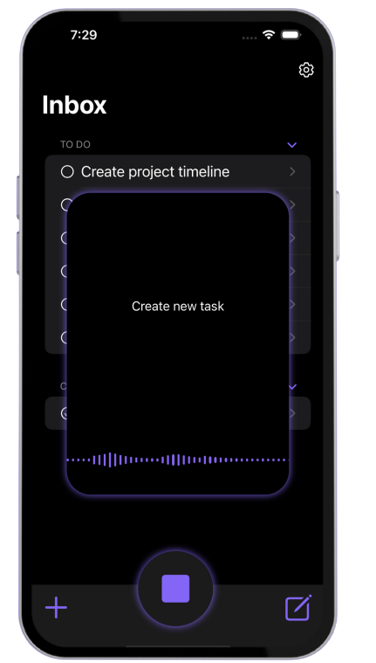
Setting daily productivity boundaries shouldn’t be a complex chore. This is where Vozly changes the game. Vozly isn’t just another place to store tasks; it is the fastest way to define your daily intention using voice technology.
Don’t waste time typing elaborate plans. While drinking your morning coffee, open Vozly and speak your daily productivity boundaries into existence:
“Vozly, today my boundary is: complete the blog post draft, send the client proposal, and pay the electric bill.”
Vozly captures this immediately. You aren’t building an infinite list; you are verbally committing to a finite, manageable day.
Frequently Asked Questions (FAQ)
What if I finish my list early, at like 2 PM?
A: This is the hardest part! You have two choices. Ideally, you stop working and use the time for learning, hobbies, or rest. This is your reward for being efficient. If you must work more, consciously add ONE bonus task, but be careful not to fall back into the “endless work” trap.
What if I don’t finish my daily productivity boundaries?
A: Forgive yourself. Analyze why you didn’t finish. Was the list too ambitious? Did an emergency happen? Move the unfinished task to tomorrow’s list and—this is key—reduce tomorrow’s list by one item to compensate.
Can I use this method for teams?
A: Absolutely. Teams that define “done” for the week or the sprint are happier and more productive than teams that work in a constant state of panic.
Conclusion: Productivity is Not About “More”
True productivity is not squeezing as much work as possible into every waking hour. It is about doing the right work, at the right time, and having the discipline to stop.
If you are tired of the endless treadmill, it is time to draw a line. You need to respect your own time as much as you respect your employer’s or your clients’ time.
Download Vozly today. Stop typing endless lists that make you feel inadequate. Start speaking your daily productivity boundaries into reality. Give yourself permission to be “done,” and watch how your focus, happiness, and work quality improve.