

You have a full to-do list. Your calendar is blocked. Your intentions are good.
And yet — by 2 PM, you feel completely drained. Not because you worked too hard. But because your brain did.
This is cognitive load productivity at its core: the gap between how much your brain can process and how much you are asking it to process at once.
Most productivity advice tells you to do more, plan better, wake up earlier. But none of that works if your brain is already running at full capacity before the real work even begins. This is the core challenge of cognitive load productivity.
In this guide, you will learn exactly what cognitive load productivity means for your daily work, why it silently destroys your focus, and five proven ways to reduce it — so you can stop feeling busy and start actually getting things done.
What Is Cognitive Load Productivity? (And Why It’s Not About Being Lazy)
In 1988, educational psychologist John Sweller introduced a concept that would quietly become one of the most important ideas in human performance: cognitive load theory.
The core idea is simple. Your working memory — the part of your brain that actively processes information — has a hard limit. It can hold roughly four to seven pieces of information at any given moment. When you push past that limit, performance collapses. Not gradually. Suddenly.
Cognitive load productivity experts compare this to RAM on a computer. You can have a powerful processor, fast storage, and a great keyboard. But if your RAM is maxed out, everything freezes.
That frozen feeling you get mid-afternoon — when you are staring at your screen but cannot seem to start anything — is not laziness. It is not a lack of discipline. It is cognitive overload. Your mental RAM is full.
The modern workplace is uniquely designed to fill that RAM as fast as possible. Notifications, unfinished tasks, open browser tabs, half-remembered commitments, background worries — each one takes up a small slice of your mental capacity. By the time you sit down to do meaningful work, there is barely any room left.
Understanding this is the first step. Because once you see cognitive load as a resource — finite, measurable, and manageable — you stop blaming yourself and start designing your day differently.
The 3 Types of Cognitive Load Hurting Your Productivity Right Now
Not all cognitive load is the same — and understanding the difference is key to improving your cognitive load productivity. Sweller identified three distinct types — and each one drains your mental energy in a different way.
1. Intrinsic Load
This is the load created by the task itself. Writing a complex report, solving a difficult problem, or learning a new skill — these activities are inherently demanding. Intrinsic load cannot be eliminated because it is the actual work. However, it can be managed by breaking complex tasks into smaller, more digestible steps to maintain high productivity.
The problem is not intrinsic load. Most people can handle a genuinely difficult task when they are fresh and focused. The issue is that cognitive load rarely arrives alone; it is the accumulation of unnecessary distractions that often hinders our performance.
2. Extraneous Load
This is the load created by everything around the task. Poor organization, unclear instructions, constant interruptions, cluttered workspaces, and — most importantly — an unreliable task management system.
Extraneous load is the silent killer. It has nothing to do with the actual difficulty of your work. It is entirely self-inflicted, created by the systems and environments we design around ourselves. Every time you have to remembersomething instead of trusting a system to hold it, you are adding extraneous load to your working memory.
This is where most people lose enormous amounts of mental energy — and where cognitive load productivity gains are easiest to find.
3. Germane Load
This is the productive type of cognitive load — the mental effort involved in building new skills, creating habits, and forming long-term memories. Germane load is what makes you better over time.
The goal of a smart productivity system is not to eliminate all cognitive load. It is to reduce extraneous load as much as possible, protect your capacity for intrinsic load, and create space for germane load to do its work.
When you understand these three types, the entire game changes. You stop trying to “work harder” and start asking a better question: where is my mental energy actually going?
5 Proven Ways to Reduce Cognitive Load and Get More Done
1. Do a Brain Dump Before You Plan
The first rule of cognitive load productivity is simple: empty before you plan and immediately start prioritizing.
Before you can prioritize, you need to empty. Every unfinished thought, half-formed idea, lingering worry, and forgotten commitment sitting in the back of your mind is quietly consuming working memory — even when you are not actively thinking about it.
Psychologists call this the Zeigarnik Effect: the brain has a tendency to keep unfinished tasks active in working memory until they are either completed or captured somewhere trustworthy. A brain dump — speaking or writing every single thing on your mind before you begin your day — closes those open loops and frees up mental capacity for the work ahead.
The key word is trustworthy. The brain only releases a task from working memory when it believes the task has been captured somewhere it will not be forgotten. A sticky note does not qualify. A mental note absolutely does not qualify. You need a system your brain actually trusts.
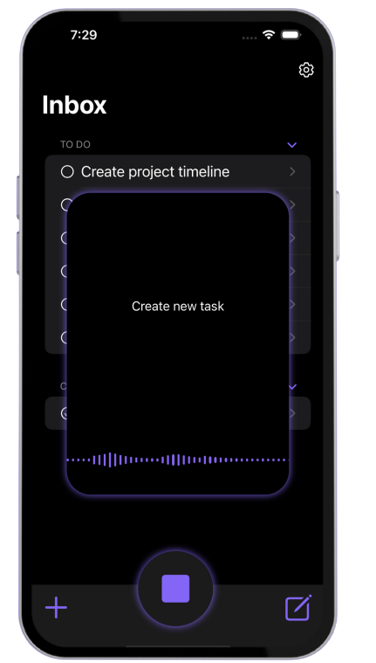
With Vozly: Open Vozly first thing in the morning and speak every task, worry, and idea that comes to mind. Vozly transcribes each one instantly into a structured task, closing the open loop and signaling to your brain that it is safe to let go. Your working memory clears. Your day begins with capacity instead of clutter.
2. Capture Tasks the Moment They Appear
Cognitive load productivity lives or dies on one habit: instant capture
You are in a meeting and someone mentions something you need to follow up on. You think: I will remember that.Three hours later, it is gone. Or worse — it is not gone. It is sitting in the back of your mind, nagging at you, consuming a small but constant slice of your working memory while you try to focus on something else entirely.
Every uncaptured task is a leak. And most people have dozens of these leaks running simultaneously.
The solution is not a better memory. It is a faster capture system. The moment a task, idea, or commitment appears — you capture it immediately. Not when you get back to your desk. Not at the end of the day. Now.
This habit is the single most effective way to reduce extraneous cognitive load in real time. It removes the mental burden of trying to remember and replaces it with the calm confidence of knowing it is captured.
With Vozly: Because Vozly is voice-first, capture takes less than five seconds regardless of where you are. Driving, walking, mid-conversation — you simply speak the task and it is done. No typing, no unlocking, no navigating menus. The lower the friction of capture, the more consistently you will do it. And consistency is everything.
3. Use One Trusted System — Not Five Apps
One of the biggest cognitive load productivity mistakes is using five different apps to manage one brain. Switch to your project management tool. Check your notes app. Glance at the sticky notes on your monitor. Look at the reminders on your phone.
Sound familiar?
Every system you add does not just organize your tasks—it adds to your cognitive load. You now have to remember which tasks live where. You have to check multiple places before you can feel confident nothing is slipping. You have to context-switch between tools, each transition costing a small but real amount of mental energy.
Research on task-switching shows that moving between different systems and contexts can cost up to 40 percent of your productive time. That is not a small inefficiency. That is nearly half your working day lost to the overhead of managing your own management system.
The most effective producers—the ones who consistently do deep, meaningful work without burning out—tend to have one single trusted system where everything lives. They don’t do this because they are minimalists by nature; they do it because they understand that a fragmented system is a cognitive load productivity killer. By centralizing their workflow, they minimize mental friction and reclaim the energy needed for high-level output.
With Vozly: Everything goes into one place. Voice notes, tasks, priorities, reminders — Vozly becomes the single source of truth for your day. When your brain knows that everything is in one trusted location, it stops spending energy trying to track what lives where. That saved energy goes back into your actual work.
4. Batch Similar Tasks Together
Every time you switch between different types of tasks, your brain has to reconfigure. It loads a new set of rules, priorities, and context. This process — sometimes called a cognitive switching cost — takes time and energy even when it feels invisible.
Answering one email, then writing one paragraph, then making one phone call, then reviewing one document is not multitasking. It is repeated context-switching. And it is one of the most expensive cognitive habits most professionals have without realizing it.
Task batching is the practice of grouping similar tasks together and completing them in dedicated blocks. All emails in one block. All calls in one block. All writing in one block. This approach dramatically reduces the number of times your brain has to reconfigure, preserving working memory for the tasks themselves rather than the transitions between them.
The result is not just more efficiency. It is a fundamentally different quality of work. When you are not constantly switching, you reach deeper levels of focus. Problems that seemed difficult become manageable. Work that felt slow starts to flow.
With Vozly: Use Vozly’s task categories to group your captured tasks before you begin your day. Instead of working through a flat list in the order things were captured, you create batches — communication, creative work, administrative tasks — and move through them with intention. Your brain stays in one mode longer. Your output reflects it — and your cognitive load productivity reaches a new level.
5. Review and Empty Your Head Every Evening
Most people end their workday by stopping. They close the laptop, walk away, and hope their brain does the same.
It does not.
The Zeigarnik Effect does not clock out at 6 PM. Every open loop you carry into the evening — every task not captured, every commitment not logged, every unfinished thought — stays active in your working memory. This is why so many people find it difficult to truly rest. The brain is not being uncooperative. It is doing exactly what it is designed to do: hold open tasks until they are resolved.
An evening review is the practice of spending ten minutes at the end of each workday to capture everything that happened, close every open loop, and set a clear intention for the following morning. It is not about reviewing your performance. It is about emptying your mental RAM so your brain can actually switch off.
The research on this is striking. People who perform a consistent end-of-day review report better sleep quality, lower anxiety, and higher focus the following morning. Not because they worked more. Because they gave their brain explicit permission to rest.
With Vozly: At the end of each day, do a quick voice review. Speak any remaining tasks, new ideas, or follow-ups that came up during the day. Vozly captures them instantly. When your brain knows that everything is safely stored in a trusted system, the compulsive need to keep holding on to it fades. You close your laptop. Your mind follows.
How Vozly Solves Cognitive Load Productivity Problems Instantly
Every strategy in this guide shares a common thread: the brain performs best when it is not asked to store information — only to process it.
This is precisely what Vozly is designed for.
Vozly is a voice-first task management app built around the idea that the fastest, most natural way to offload a thought is to speak it. Not type it. Not navigate to it. Just say it.
When a task appears in your mind, speaking it into Vozly takes less than five seconds. The thought is captured, structured, and stored. Your working memory is immediately free. There is no friction between the thought and the capture — and in cognitive load terms, friction is the enemy. Every extra step between having a thought and recording it is an opportunity for that thought to stay in your head instead of your system.
Over time, the habit of instant voice capture creates something powerful: a brain that trusts its system. And a brain that trusts its system stops holding on. It stops maintaining background threads of worry and half-remembered tasks. It focuses. It rests. It performs.
Vozly does not promise to make you more disciplined. It promises to make the right behavior — capturing, organizing, reviewing — so fast and frictionless that discipline barely enters the equation.
That is what reducing cognitive load actually looks like in practice. Not a complicated framework. Not a rigid system. Just a tool that gets out of the way and lets your brain do what it does best.
Conclusion
Cognitive load productivity is not a buzzword. It is the reason your best intentions often go nowhere.
When your working memory is full — with unfinished tasks, uncaptured ideas, fragmented systems, and constant context-switching — there is no room left for the work that actually matters. Not because you are incapable. Because your brain is overloaded.
The five strategies in this guide are not about working harder. They are about working with your brain instead of against it. Brain dump before you plan. Capture instantly. Use one system. Batch your tasks. Empty your head at the end of every day.
Each of these habits reduces the extraneous load that silently drains you — and returns that capacity to the work that deserves it.
If you want to make all five of these habits significantly easier to maintain, Vozly was built for exactly this purpose. Voice-first, fast, and frictionless — it turns cognitive load management from a discipline into a default.
Your brain has more capacity than you think. You just have to stop asking it to do jobs it was never designed for.
Try Vozly today and give your brain the breathing room it deserves.

What is cognitive load in simple terms?
Cognitive load refers to the total amount of mental effort your working memory is using at any given moment. When that load exceeds your brain’s capacity — which is limited — focus, decision-making, and performance all decline. Reducing cognitive load means designing your work and environment so your brain spends its energy on real work, not on remembering, tracking, and managing information.
How does cognitive load affect productivity?
High cognitive load productivity drain directly reduces your ability to focus, make decisions, and complete complex tasks. When your working memory is occupied with unfinished to-dos, unresolved thoughts, and fragmented systems, there is little capacity left for the meaningful work that actually moves your day forward. Reducing extraneous cognitive load — the load caused by poor systems and disorganization — is one of the fastest ways to improve productive output without working longer hours.
What is the best tool to reduce cognitive load at work?
The best tool is one that captures tasks instantly, stores them in a single trusted location, and requires as little friction as possible to use. Voice-first tools like Vozly are particularly effective because speaking a task is faster and more natural than typing — reducing the cognitive cost of the capture process itself. When the system is fast enough, your brain learns to offload rather than hold on, which is the foundation of sustainable, high-performance focus.