Productivity psychology
7 Biases That Hinder Our Time Management

Why do we constantly procrastinate, miss deadlines, and fail to manage our time efficiently? Or why do we say “yes” to unnecessary things and stay in careers that make us unhappy? Managing time is a challenge many people face.
Research on cognitive biases, from Tversky and Kahneman (1974) onward, suggests that people make systematic, recurring mistakes in judgment, including in how we manage time. In this article, we’ll explore seven mental errors that can affect task prioritization and goal achievement. These seven are a practical selection, not a standard list from the research literature. We’ll also discuss ways to avoid these mistakes.
1-Urgency Effect
Why do unimportant tasks dominate our days?
There will always be more tasks than time. So, how should we prioritize? The urgency effect refers to our tendency to prioritize tasks with time pressure over long-term, more important tasks. For example, emails feel urgent because someone is waiting for a response, but our most important goals can often seem postponable since they are long-term.
What can you do about it?
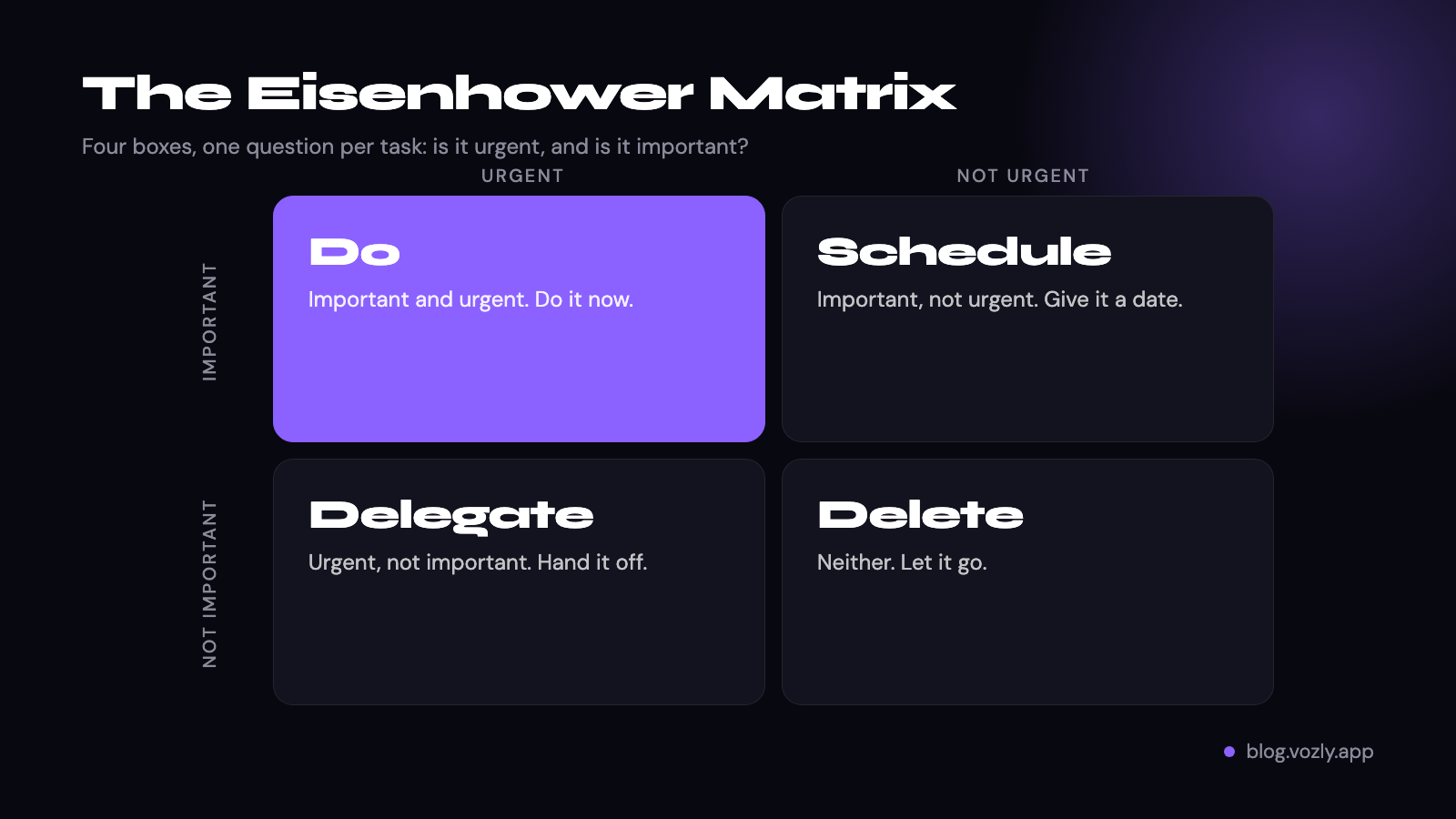
Prioritize tasks using the Eisenhower Matrix. This tool helps you classify tasks as “urgent/not urgent” and “important/not important.” Depending on which quadrant the task falls into, you can decide how to take action. In Vozly you can place your to-dos in the free Eisenhower Matrix, by hand.
Dedicate 2-4 hours of your most productive time to your most important task. Identify the hours when you’re most efficient and allocate this time to critical tasks. Block this time in your calendar and try to focus without interruption.
Set deadlines for important tasks. Set a clear date for when a task needs to be completed. This helps prevent procrastination and keeps you focused.
2-Zeigarnik Effect: Why Can’t We Stop Thinking About What We Have to Do?
The Zeigarnik Effect refers to the claim that unfinished tasks are remembered better than finished ones. The evidence for it is mixed (a 2025 meta-analysis found no overall memory advantage), but a related finding is better supported: Masicampo and Baumeister (2011) found that unfinished goals caused intrusive thoughts and worse performance on an unrelated task.
For example, let’s say you started working on a project but didn’t finish it. No matter what you do for the rest of the day, that project may keep coming back to mind. The same studies found that making a specific plan for the unfinished goal removed these effects.
This helps explain why unfinished tasks can feel stressful at the end of the day. Many people also find that starting a small part of a task makes it easier to come back and finish it.
What can you do about it?
Write down your tasks, or speak them into Vozly if writing feels burdensome.
Organize and review your tasks regularly. Create a system that works for you and consistently use it to keep track of your tasks.
3-Planning Fallacy: Why Do We Miss Deadlines? Insights into Better Time Management
Next time your boss asks why you missed a deadline, blame your brain.
The Planning Fallacy (Buehler, Griffin and Ross, 1994) is our tendency to underestimate how much time we need to complete a task. We often don’t account for the fact that finishing a project will take longer than expected. This error leads to missed deadlines or increased stress. We make optimistic estimates and overlook potential setbacks or delays.
For example, you think it will only take a few hours to finish a report, but gathering data, editing, and final checks extend the task, causing you to miss the deadline.
What can you do about it?
Add time buffers: After estimating how long a task will take, add extra time to account for unexpected situations. This buffer will help prevent missed deadlines.
Break tasks into smaller parts: Divide large projects into smaller, manageable steps. This way, you can plan each stage more accurately and monitor your progress, enhancing overall time management by allocating specific time slots to each task.
Learn from past experiences: Look at how much time you spent on similar tasks in the past, and use these as guides for future projects.
4-Sunk Cost Fallacy: Why Do We Continue Making Bad Decisions?
Have you ever started a movie and realized halfway through that it’s terrible but kept watching anyway? Congratulations, you’ve fallen victim to the Sunk Cost Fallacy!
The Sunk Cost Fallacy (Arkes and Blumer, 1985) refers to our tendency to continue bad decisions because we’ve already invested time, money, or energy into them. Thinking “I’ve spent so much time on this, I might as well finish it” is actually irrational because the resources spent cannot be recovered. Yet, many people continue making wrong decisions, leading to even bigger losses. Recognizing this fallacy can improve time management by allowing individuals to reallocate their time to more productive endeavors instead of persisting with unprofitable projects.
For example, you’ve spent hours watching a movie and realize it’s boring. But you think, “I’ve watched this much, it’d be pointless to stop now,” even though stopping and using that time for something more enjoyable or productive would be a better choice.
What can you do about it?
Review the return on your investments: It doesn’t matter how much time, money, or energy you’ve already spent on a project, job, or event. What matters is whether these investments will benefit you in the future. If there’s no return, the best decision may be to let go.
Focus on the future: Past expenses cannot be recovered. Therefore, make decisions based on potential future gains or losses. Accepting the loss is better than continuing to lose.
Increase awareness: When you realize you’re falling into the sunk cost trap, stop and reflect. Ask yourself, “Will continuing this decision cost me more time/money?” Try to view the situation objectively to find a rational exit.
5-Present Bias: Why Do We Seek Instant Gratification?
Present Bias (see O’Donoghue and Rabin, 1999) refers to our tendency to choose immediate rewards over long-term benefits, even when we know the long-term option is better. This bias causes us to prioritize short-term pleasures at the expense of long-term goals, delaying healthy habits or failing to focus on long-term objectives.
For example, you have a diet plan for a healthy lifestyle and weight loss, but instead of rejecting a slice of cake, you break your diet for instant gratification. Even though better health and weight control offer long-term benefits, you choose the short-term pleasure of eating the cake.
What can you do about it?
Set small goals: Break down your long-term goals into smaller, more manageable steps to experience the feeling of achievement more frequently. Each small success gives you instant gratification while also helping you progress toward your bigger goal.
Remind yourself of long-term gains: When you’re tempted by short-term gratification, remind yourself of the long-term benefits you’ll gain. For example, eating a healthy meal instead of indulging in a sweet treat will make you feel better in the long run.
Plan short-term rewards: While pursuing your big goals, set small rewards for yourself. This way, you can experience a sense of satisfaction while staying focused on your long-term objectives. For example, give yourself a small reward when you meet your weekly goals.
6-Complexity Bias: Why Do We Overcomplicate Our Lives?
Complexity Bias, a popular label rather than an established research finding, refers to our tendency to favor complicated solutions when simpler ones are available. People often choose more complex methods to solve problems because complexity creates the illusion that the solution is more effective or valuable. In reality, simple solutions are often more effective and sustainable, but due to complexity bias, we unnecessarily complicate our lives.
For example, there may be a simple to-do list app you can use to organize your workload. However, you opt for a complex project management software that tracks every detail. Learning, setting up, and using this software takes more time and adds stress rather than simplifying your tasks.
What can you do about it?
Choose simple solutions: Don’t assume that the more complicated option is better. Look for simple and effective solutions to the problems you face. Focus on the solution’s effectiveness rather than its complexity.
Adopt a minimalist approach: Simplify your tasks, projects, and life by eliminating unnecessary details. Start with simple methods and only resort to more complex solutions when absolutely necessary.
Get rid of excess: Instead of constantly trying new tools, methods, or systems, focus on the simple things that already work. Choose solutions aimed at increasing efficiency rather than complexity.
7-Hedonic Adaptation: Why Does Good News Start to Feel Ordinary?
Hedonic Adaptation refers to how people adapt to positive or negative events over time, so that the initial excitement or unhappiness fades. You may get a promotion, a raise, or reach a certain number of social media followers, and this makes you happy for a while. However, after a time, you get used to it and start looking for more. Researchers have refined this idea: Diener, Lucas and Scollon (2006) argue that people do not simply return to a neutral baseline and that well-being can change under some conditions. Still, getting used to good news is a common pattern.
For example, you may feel excited and happy when you get a long-awaited promotion. But after a few weeks or months, you adapt to the happiness this new position brings, and you begin to chase the next goal. What once seemed like a great success now feels ordinary, and you continuously seek more.
What can you do about it?
Practice gratitude: Regularly reminding yourself of what you have is a popular way to counter the constant chase for more.
Focus on long-lasting sources of satisfaction: Instead of material successes, consider investing in things like relationships, meaningful projects, or personal growth, which many people find more satisfying than fleeting thrills.
Balance your goals: It’s great to set high goals, but learn to enjoy the journey instead of constantly chasing the next big thing. The experiences you gain along the way can be as valuable as achieving success.
Also read
Productivity
Eisenhower Matrix: 5 Ways to Stop Reacting to Fake Urgency
How the Eisenhower Matrix helps you tell urgent from important, and how capturing tasks by voice in Vozly can make sorting them easier.

Productivity
Study Productivity App for Students: Manage Time and Notes with Voice
Voice notes, a Pomodoro timer and an Eisenhower Matrix: how a study productivity app like Vozly can support students during exam season.

Productivity psychology
The Mere Exposure Effect: Why Repetition Changes Our Feelings
What the mere exposure effect is in psychology: how repetition and familiarity can shape our feelings, habits, and even the music we listen to.


